
Esoteric Ebb
I refuse to back your foolish quest to Make a Friend.

Attempt to describe the game without referencing another, similar game. DC 15
Wisdom roll: 14. Failure.
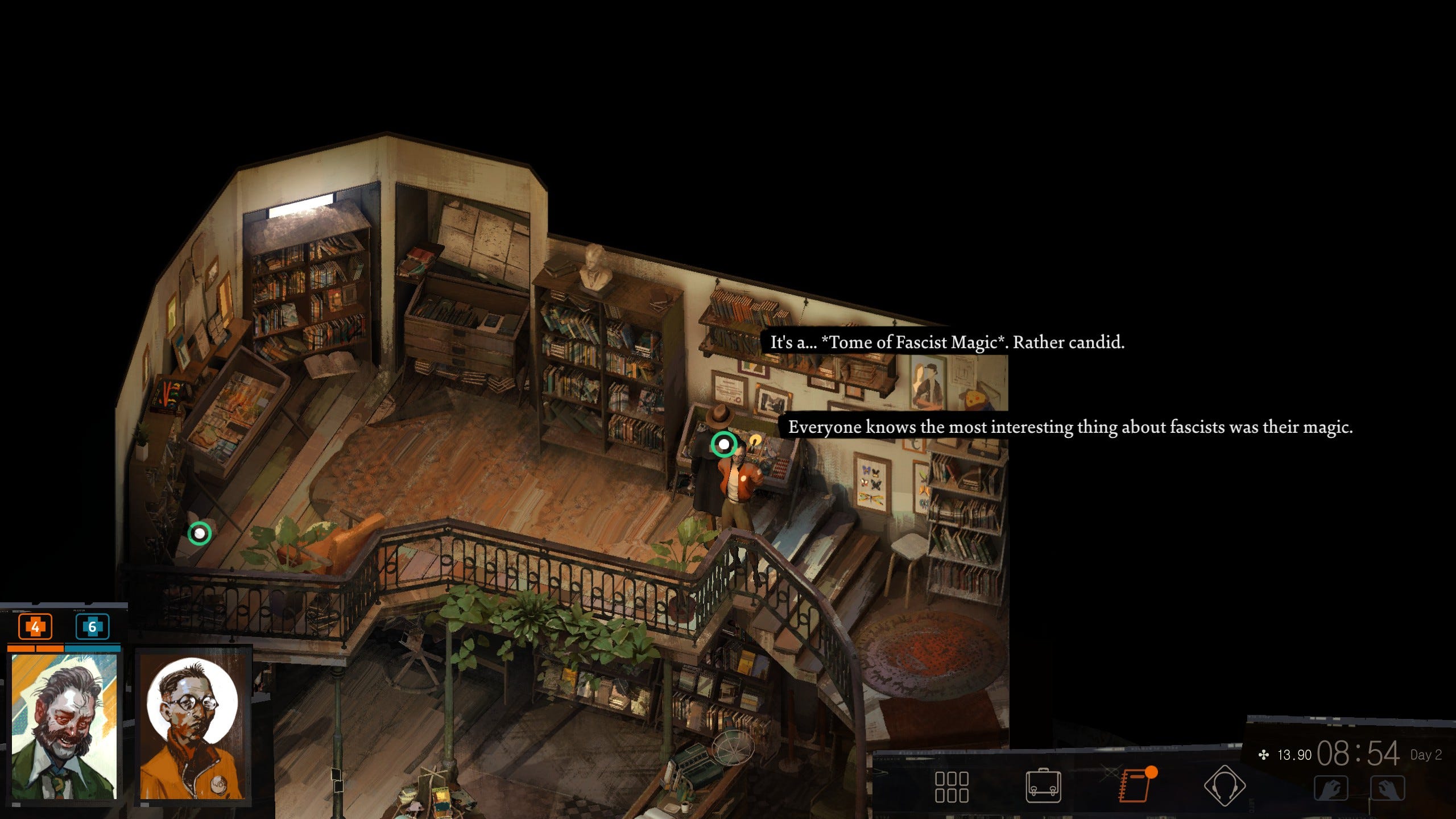
Disco Elysium came out several years ago, in the midst of a slow-burn revival of isometric RPGs that eventually culminated in the resurrection of the Baldur’s Gate franchise. What made DE stand out from the crowd was… well, pretty much everything about it. The setting was unique, the art and designs were stylish and evocative, it nearly completely discarded any pretense of standard gameplay to make the entire game a glorified series of dialogue trees, and it was extremely political, albeit in the broader sense of reducing everything possible to politics rather than taking any particular political stance as a whole. It was very of its time, highly divisive, memorable, and most of all, impossible to live up to. I’ll be honest, I don’t even think Disco Elysium itself holds up all that well in comparison to its first impression. Not a lot has come out that directly apes DE, especially not with a comparable level of effort.
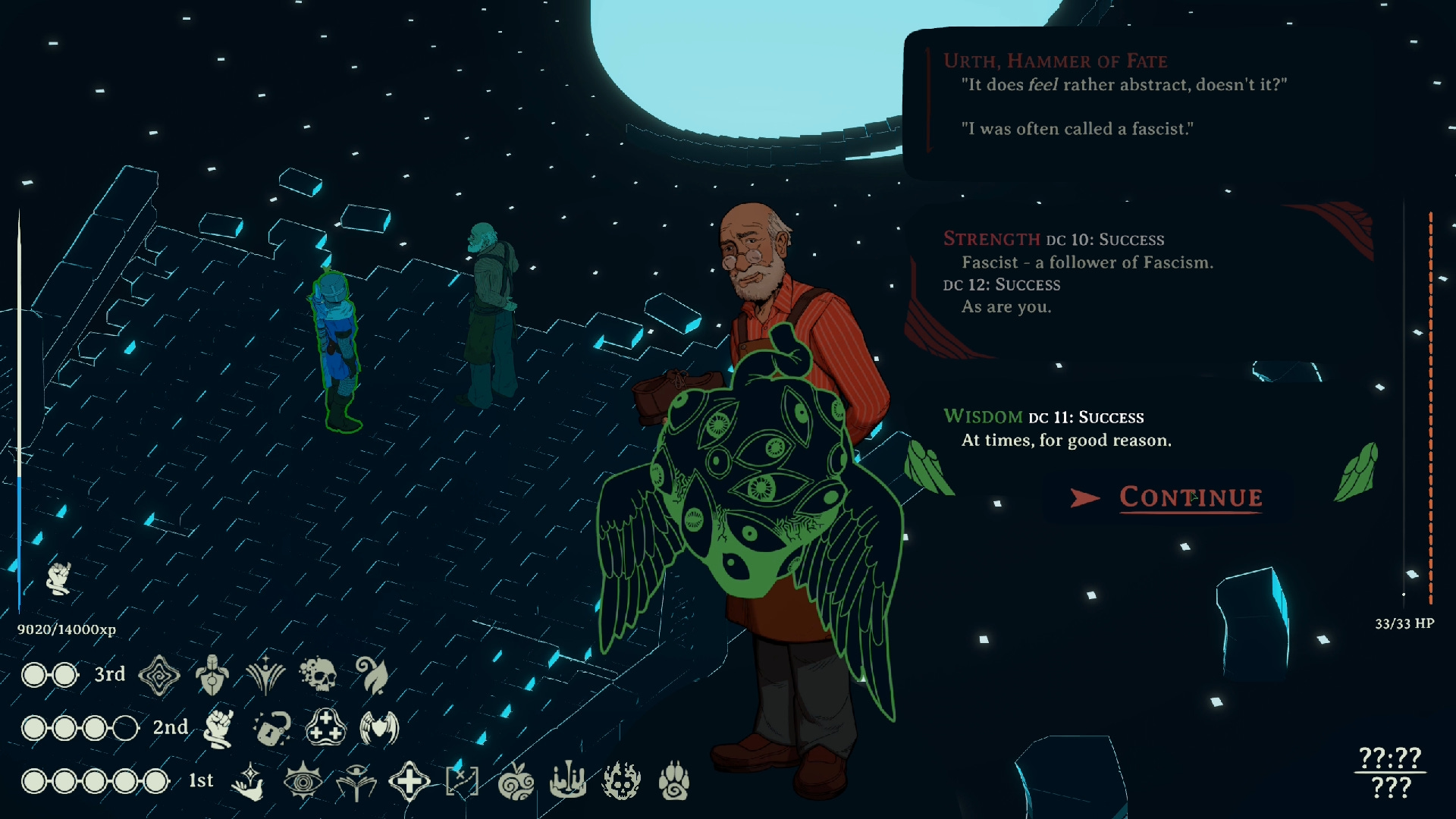
Well, Esoteric Ebb does just that. Ebb has a lot of very straightforward parallels to DE – you’re essentially a cop sent to solve a relatively small-stakes incident, you’re given a few days, most of which you actually spend pursuing minor unrelated or tangential threads, and your stats crop up frequently as inner voices during conversations, urging you towards complimentary actions or revealing intuitions they’ve given you. Broadly speaking, you could satisfactorily sum up Ebb as an attempt to craft a Disco Elysium style narrative adventure in a Dungeons and Dragons setting. Happily, Ebb’s developer rolled pretty high against that Difficulty Class.
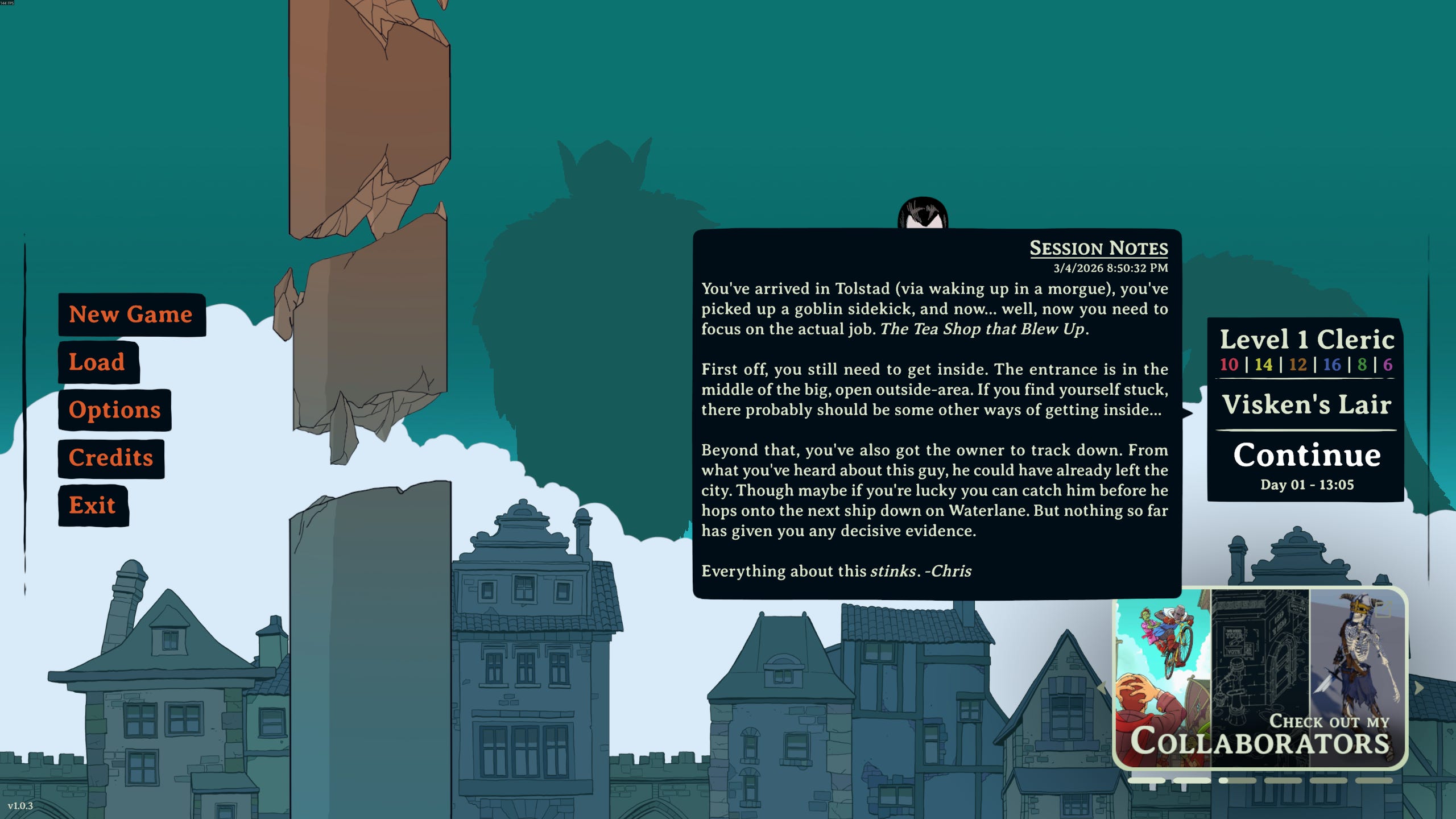
After a bit of character creation, you begin the game, in another example of obvious inspiration, waking up on a mortuary slab, having lost your [short term] memories, your levels, and most importantly, your spellbook. Following some internal dialogue with your stats and external dialogue with the mortician, you gather your wits enough to recollect your mission: you are a Cleric, sent by the authorities to investigate a tea shop that suspiciously exploded. You’ve got until the end of the week to settle things, because the City doesn’t want it hanging over the impending event set to alter the course of history – the first ever democratic election held in the nation of Norvik.
The game takes place in a homebrew setting for D&D, and the history and geography is creative enough that I really enjoyed digging through the expository asides my high Intelligence stat offered from highlighted glossary terms throughout. Actually, the way that the game drip feeds the worldbuilding, character traits, and your Cleric’s history is just a highlight of the game in general. There’s a lot going on, and it’d be really overwhelming if too much of it was thrown at you up front rather than mentioned offhand during conversations about more immediate matters. That said, you can spend a lot of time, both real and in-game, going down rabbit holes that provide little other than more background details that are largely irrelevant, if you like.
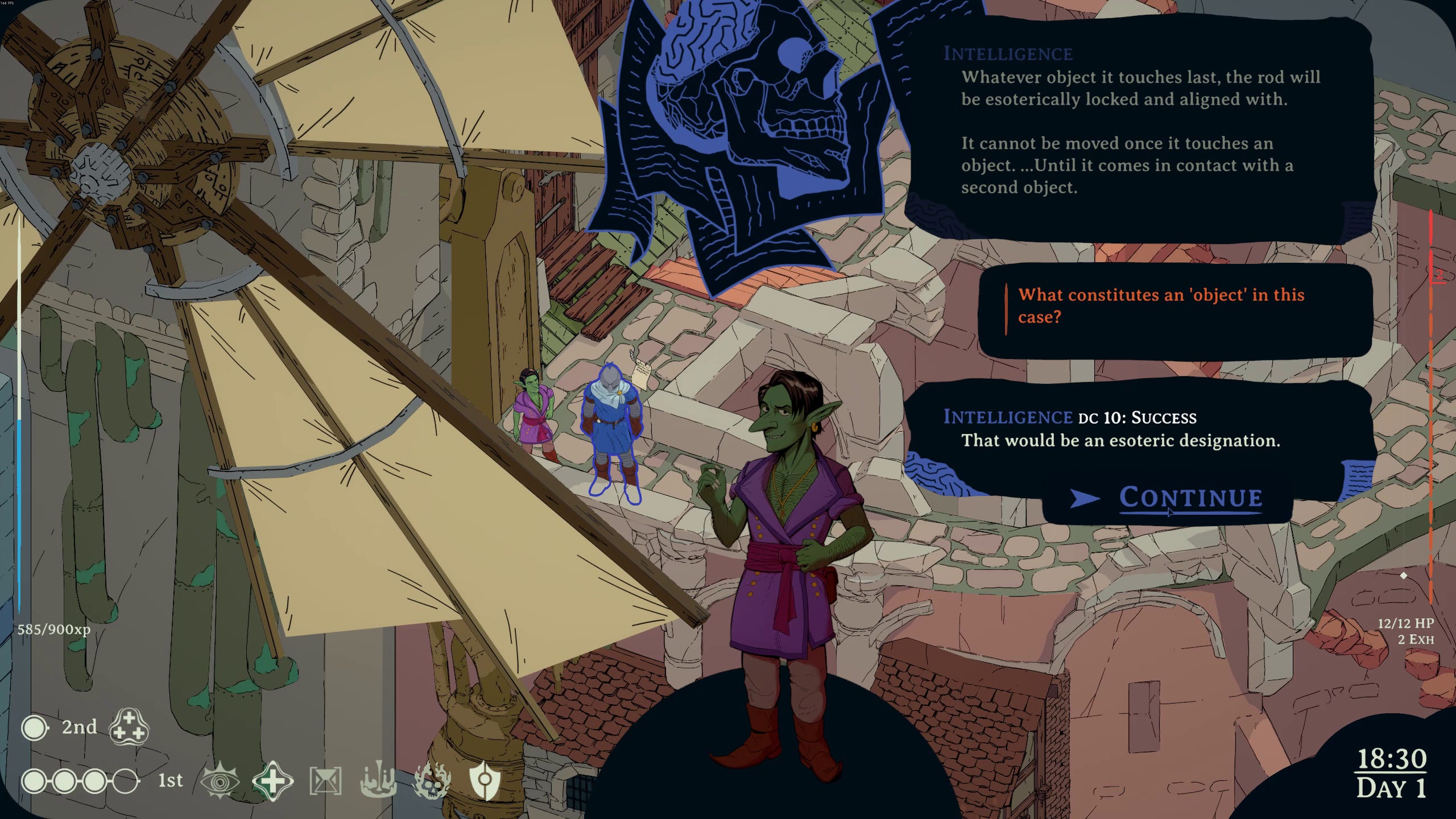
This being a Disco-like in many respects, most of the gameplay consists of going around, finding context prompts, and having lengthy conversations with NPCs. [or yourself] The island fortress-cum-mercantile hub that makes up the sole playable space for the campaign is surprisingly dense and deep, and there’s more than enough to find through exploration and revisits to feel like a proper CRPG location. The characters you’ll be talking to, being the centerpiece of the game, are equally substantial – anyone with a name has loads of dialogue, a vibrant character portrait, their own stats, multiple occasions or even locations to engage with them throughout the week, and so on.
One of my favorite features of the game are the Behold checks – examining a named NPC gives you a once-per-day opportunity to essentially give them an up-and-down, followed by a gut check read on them against a relevant stat. It’s not purely pass or fail, either, with each tier you clear earning you progressively deeper snippets of their character bio – their disposition, their motivations, all from the way they hold themselves or their slight mannerisms or just the vibe they give off. Some of it should be obvious anyway from talking with them, some of the deeper ones are the sort of thing they probably don’t even consciously know about themselves, and it’s exactly the kind of mechanic that works perfectly for this style of game and rings true to life. If you visit a character every day, you’ll get enough chances at it to probably get a solid read on what they’re really like, some motherfuckers you’ll clock the instant they make eye contact, and a couple people you’ll part ways with never really knowing what made them tick. Plus, it’s just a cute excuse to give everyone big, detailed character sheets in-game.
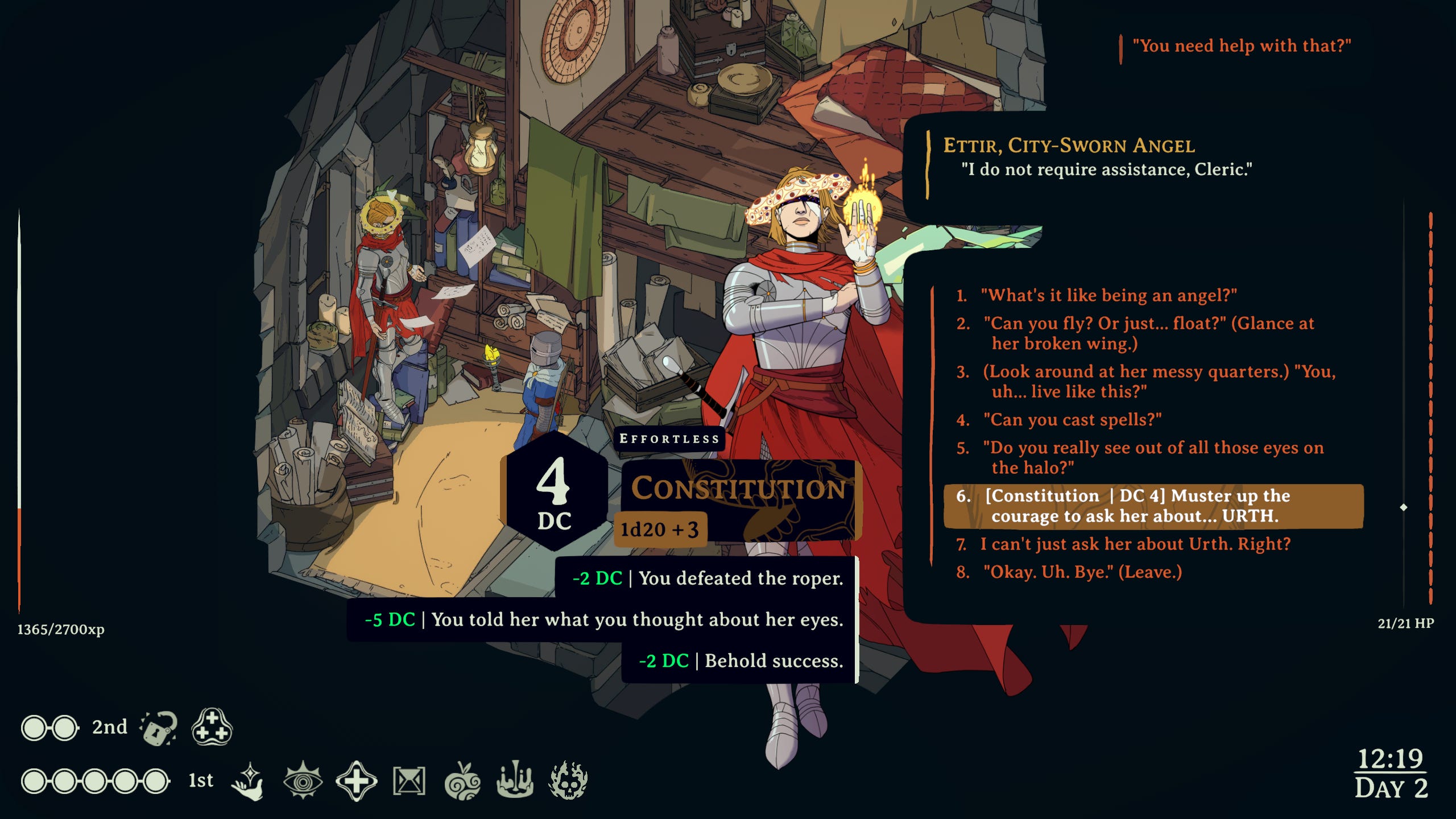
Another thing Ebb does really well are the ability checks in general – it’s all d20 rolls, modifiers based on your relevant stat, against a set value that is always presented to you up-front. Your stat scores can be affected by spells, equipment [of several different types] and permanent consumables, and there are a few ways to gain Advantage on certain types of roll, but more importantly, there are almost always multiple external and internal ways to affect the DC value of a given action. You might, for example, make a jump easier if you psyche yourself up first, or soften someone up with a little praise or banter before going in deep. It’s not always positive either – people will remember things you did to piss them off before, and that’ll make it harder, but not impossible, to extract useful information later. The game includes several extremely high DCs that you’re supposed to come back to with more information, rather than just savescum until you get a natural 20, and sometimes, it’s actually worth trying and failing.
Many times, ability check failures don’t permanently lock you out of attempting an action again – there is a particular consumable that lets you re-attempt most checks, and sometimes ‘failing’ at something difficult instead puts you on a longer, more arduous, or painful route that still ends with you getting the intended reward… even if it’s not necessarily worth the trouble. But even when you do screw something up royally, it’s rarely a total loss or worth a reload, because the game saves a lot of the best flashbacks and revelations about your own character for the moments you fuck up so bad all you can think of is how much of a fuckup you are, and how all your worst fuckups have led you to this point.
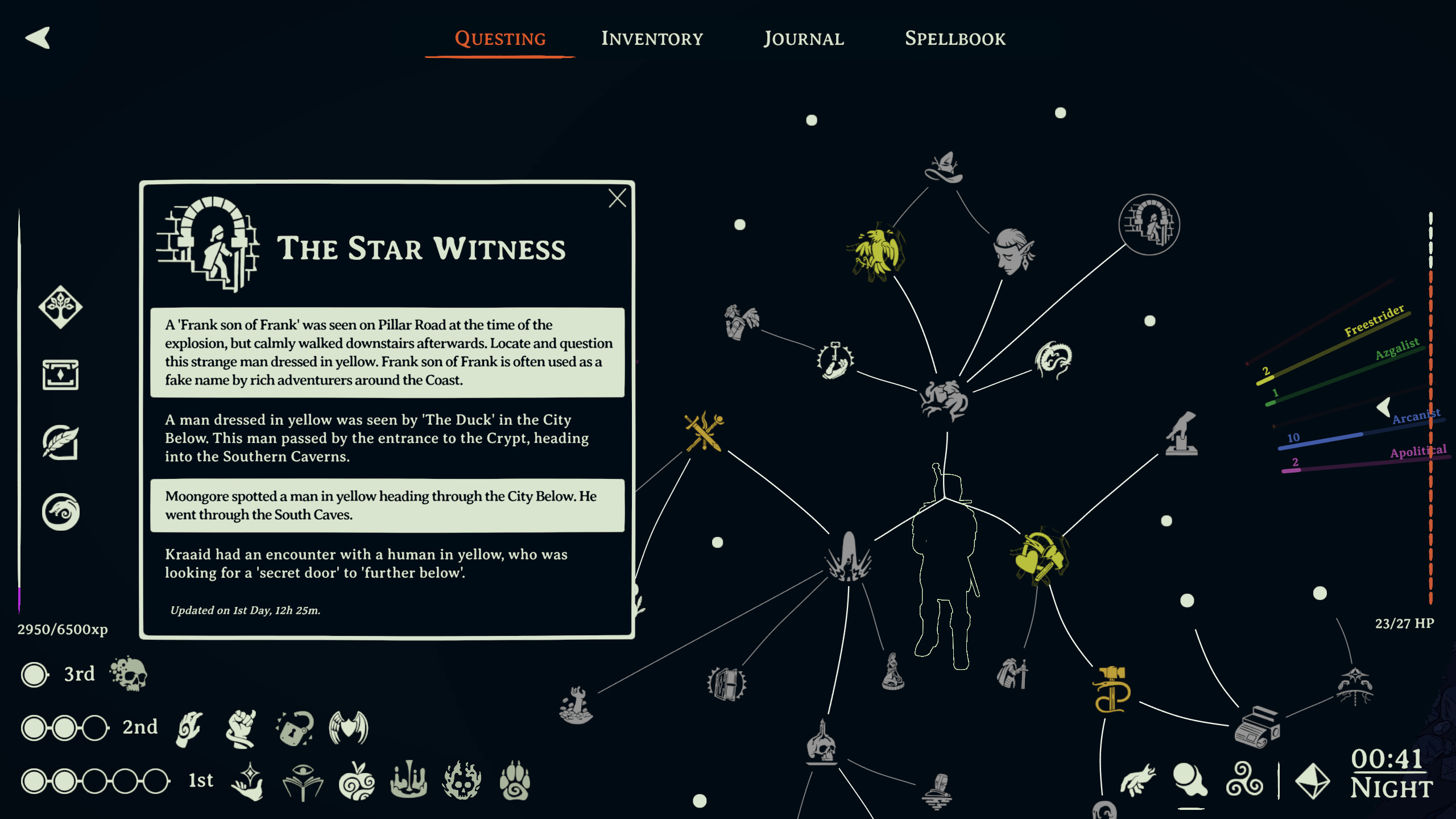
Another really surprising thing is how well character development and progression works – it’s obviously not a particularly combat-oriented RPG, so while you still do have levels that determine your hit die and spell slots and so forth, most of your XP comes from dialogue and completing quests. One of the running jokes in the game is how desperate the Cleric is for anything that could, even tenuously, be described as a ‘quest,’ and throughout the game you’ll pursue several distinct ones, most of which are, possibly, arguably, mildly related to your actual official assignment. Seeing the bigger of these through to a sensible ending point then gives you an opportunity to reflect on them internally, host a debate between two or more of your stat voices, and finally, pick a perk that encapsulates what you took away from the situation, on a personal level. You can only equip four different perks at a time, but unlocking them is also by far your biggest source of XP, so it’s worth spending a few minutes on even if you’re not going to actually use any of them.
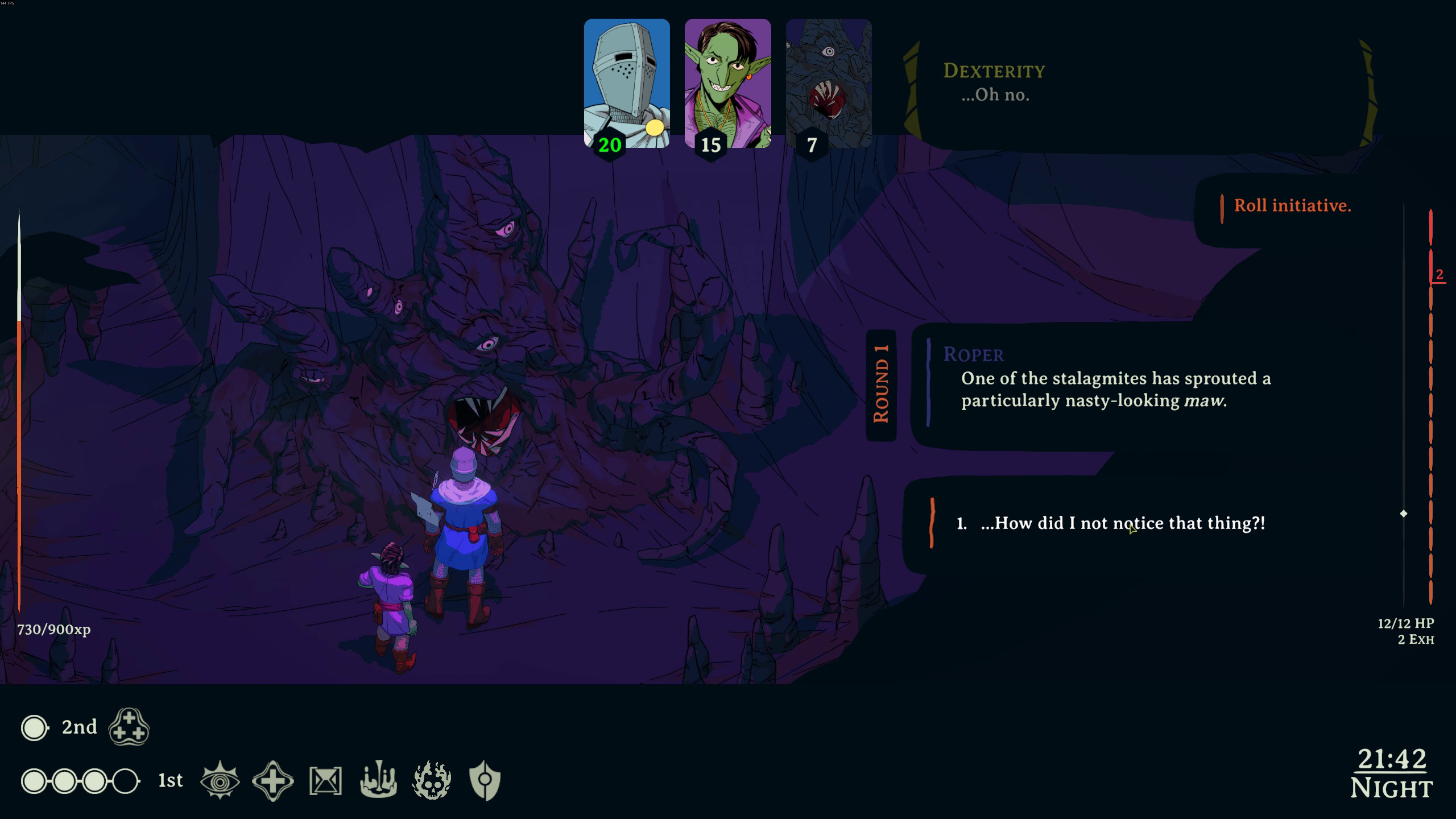
But just because there’s not a lot of combat compared to a normal RPG doesn’t mean there’s none – there are a decent number of combat encounters throughout the game, some of which you can avoid or de-escalate before the initiative rolls start, but a few you’re almost certainly going to have to deal with legitimately. Combat essentially plays out like a fight in a Choose-Your-Own-Adventure book, with DC rolls depending on which action you opt for each time your turn comes up. It’s certainly not very tactical or complex – battles progress in a set sequence, and your actions, if successful, mostly serve to mitigate the damage you take or give you bonuses toward the ‘killing blow’ once the encounter reaches its conclusion. Other party members act on their own, you can opt to cast any relevant memorized spells on your turn, but you’re not really trying to drain the enemy’s health pool or counter their spells or anything like that.
Oops, I spoiled that you get party members! Really, the important one is Snell, a goblin assigned to shadow you by the local tribe leader, who is essentially the stand-in for Disco’s Kim Kitsuragi – he mostly acts as your straight man, a foil for your antics and poorly-chosen statements, giving you someone to bounce ideas off of, and pitching in during combat or trap encounters and the like. Like Kim, you can ditch him at night or not meet up with him in the morning if you really want to go it alone or need to do something you don’t want anyone else knowing about, but he’s almost always a boon, and the game is very clear that you’re meant to keep him around as much as possible. Thankfully, he’s also not annoying or grating, and the interactions between Snell and the Cleric are some of the best in the game.
The side characters are all very good too, though. Almost none of them come across as entirely one-note, the setting allows for a very diverse cast without it feeling forced, and everyone gets at least some fleshing out. One of my favorite moments was finding a Sending Pebble, which is a magical device that lets you send a telepathic voicemail to people you know nearby, and seeing every major character’s reaction to being very mildly irritated when you bug them for no good reason.
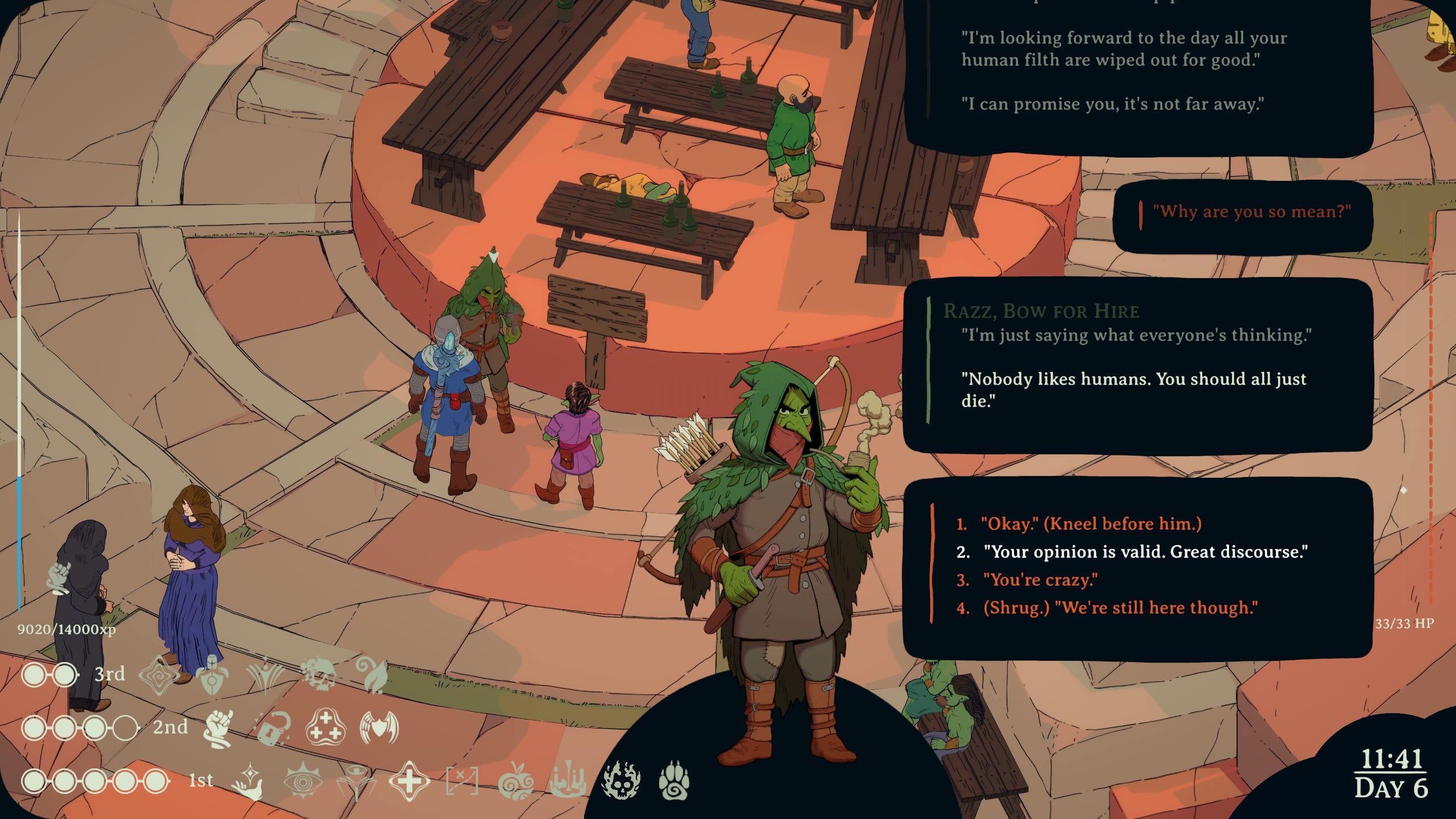
The upcoming election is, in many ways, the focal point of the entire plot and underpins a lot of the game, and it’s where Esoteric Ebb gets political – the setting is intentionally very anachronistic, and has very obvious parallels to real-world events and history, with a healthy layer of arbitrarily convenient magic filling in the technological and sociological gaps. The game does a pretty good job of keeping itself fairly neutral while providing options for your Cleric to express a variety of viewpoints, even extremely offensive or contradictory ones, and as you put together more of your own backstory, they all manage to make some sense as a legitimate internal struggle being brought to a head by the prospect of casting a vote. Another running gag is that you are able to pester just about any named NPC to tell you who they’re going to vote for, then announcing to them your own plans, which can be different every time [though you get a slight XP bonus for saying one option a lot] and which very few people actually care about, even when you brag that you’re apolitical or are going to write yourself in.
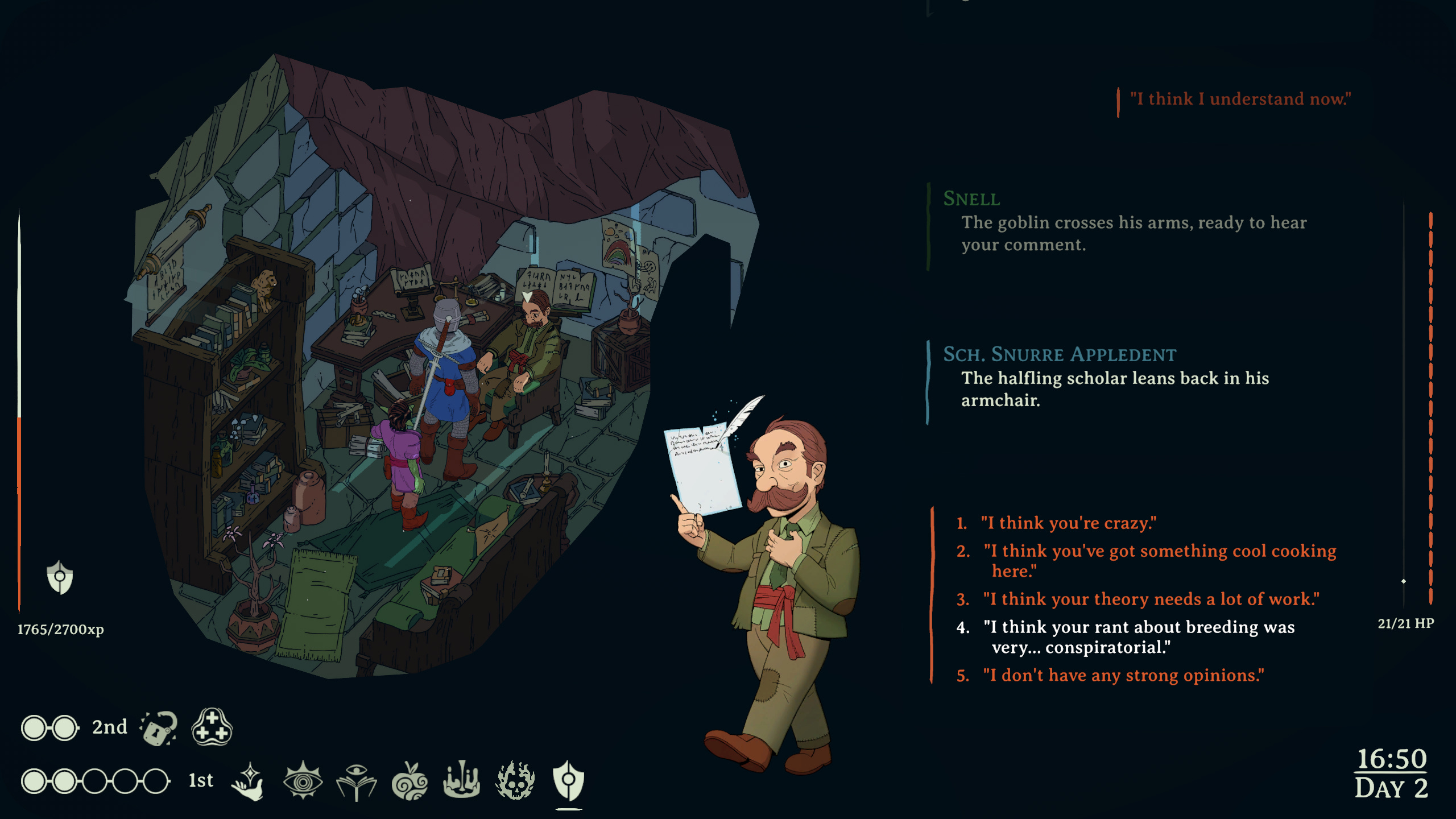
All that, and much of the character development, could come off as tacky or insincere if the writing were worse, but it’s genuinely very solid. There are some on-the-nose references here and there, there’s some pretty corny options, but in general it’s got a consistently light tone, is a breezy read for how much text you’ll be swamped with, and throws in plenty of jokes that land. Most of all, I think it’s a fun and interesting setting that gets revealed to the player gradually and in clever ways, without being too obvious or patronizing.
Time advances primarily through conversation and opt-in activities, but is thankfully frozen while you’re just walking around deciding what to do or looking for new things to engage with. Most of the real time-sinks warn you in advance before you get locked in for an hour or more, but you really will pass time pursuing leads, and it does have an effect. NPCs will move around or become [un]available depending on the day of the week and hour, some areas open later, and, maybe most importantly, you eventually start to succumb to exhaustion, each level capping your max health and adding additional malus to every DC roll you attempt. The passage of time wound up feeling a lot more important than it ever was in Disco, and I missed a lot of mornings from staying up until 4 AM in my first playthrough.
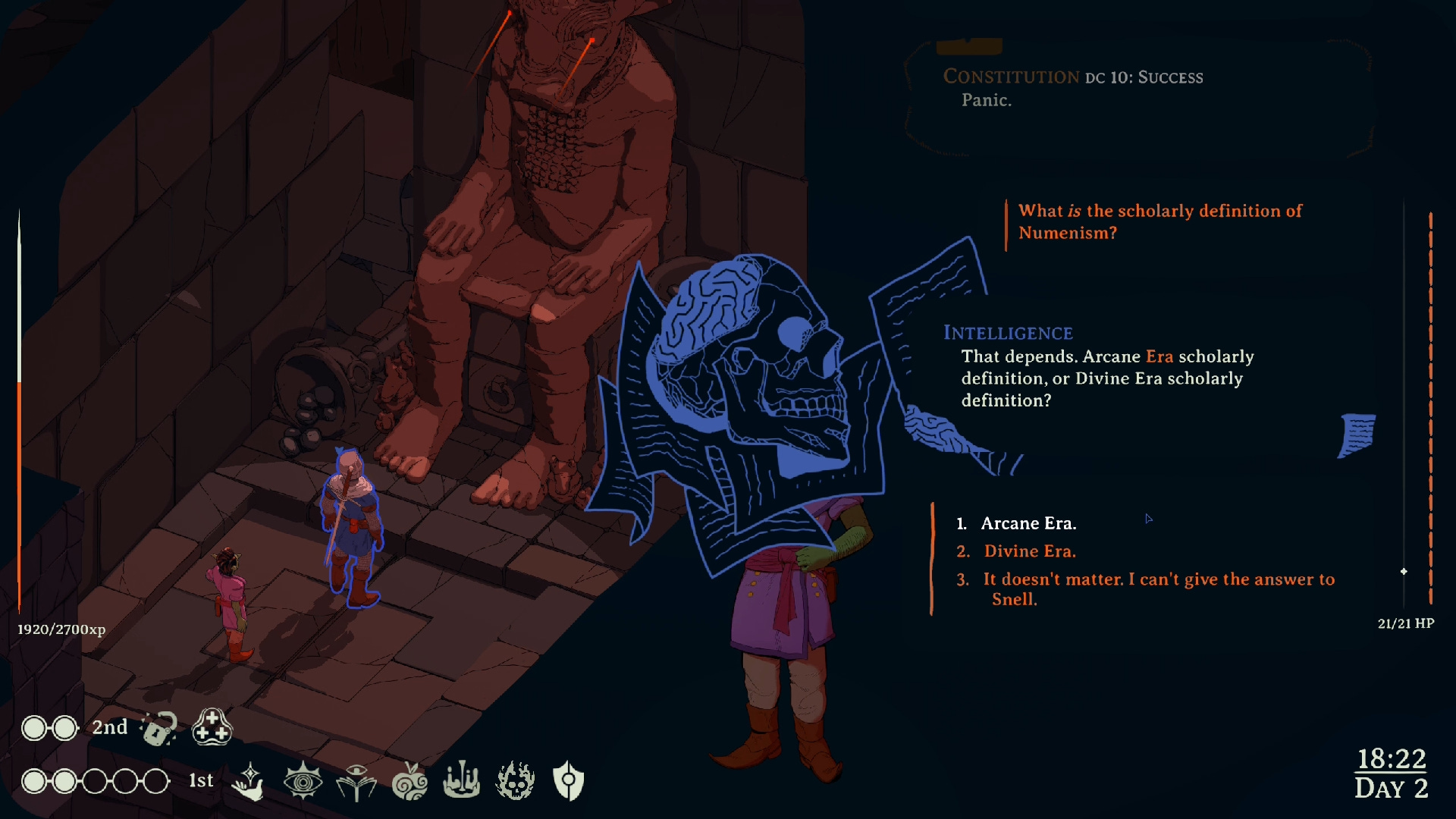
The music is inoffensive, and suits the mostly relaxing exploration and dialogue just fine, but I really liked the art direction – detailed, bright, and full of character while still readable and clean. The interaction highlights are generally pretty big, and there’s very little even optional pixel-hunting, and mostly just for a few extra consumables. Really, the only negative I have about it is that the game spaces sometimes include walkable paths behind foreground objects, some of which are just kind of confusing and fidgety to navigate, even in the normal above-ground city areas.
Speaking of negatives, I’ve got a few more nitpicks. The game absolutely throws consumables at you, healing items, spell slot restores, DC rerolls, you’ll be swimming in them by endgame and it dampens the impact of a lot of mechanics. It’s not like the game has a particularly strict time limit, and while I wasn’t just long-resting after every single remotely straining encounter like I was by halfway through BG3, it definitely could’ve tried a little harder to punish me for repeatedly casting Speak with Animals to ask a crab their political leaning. That also brings me to the next issue, which is that the economy is largely irrelevant, for a few reasons. The main one is that the majority of worthwhile items you can spend money on can also just be pickpocketed – a trivial thing to savescum, isn’t that hard, rarely has a negative impact on anything even if you get caught, and doesn’t seem to so much as hurt people’s feelings or cause them to distrust you if you steal something they intend to give you and then wave it in their face and say ‘I stole it earlier.’
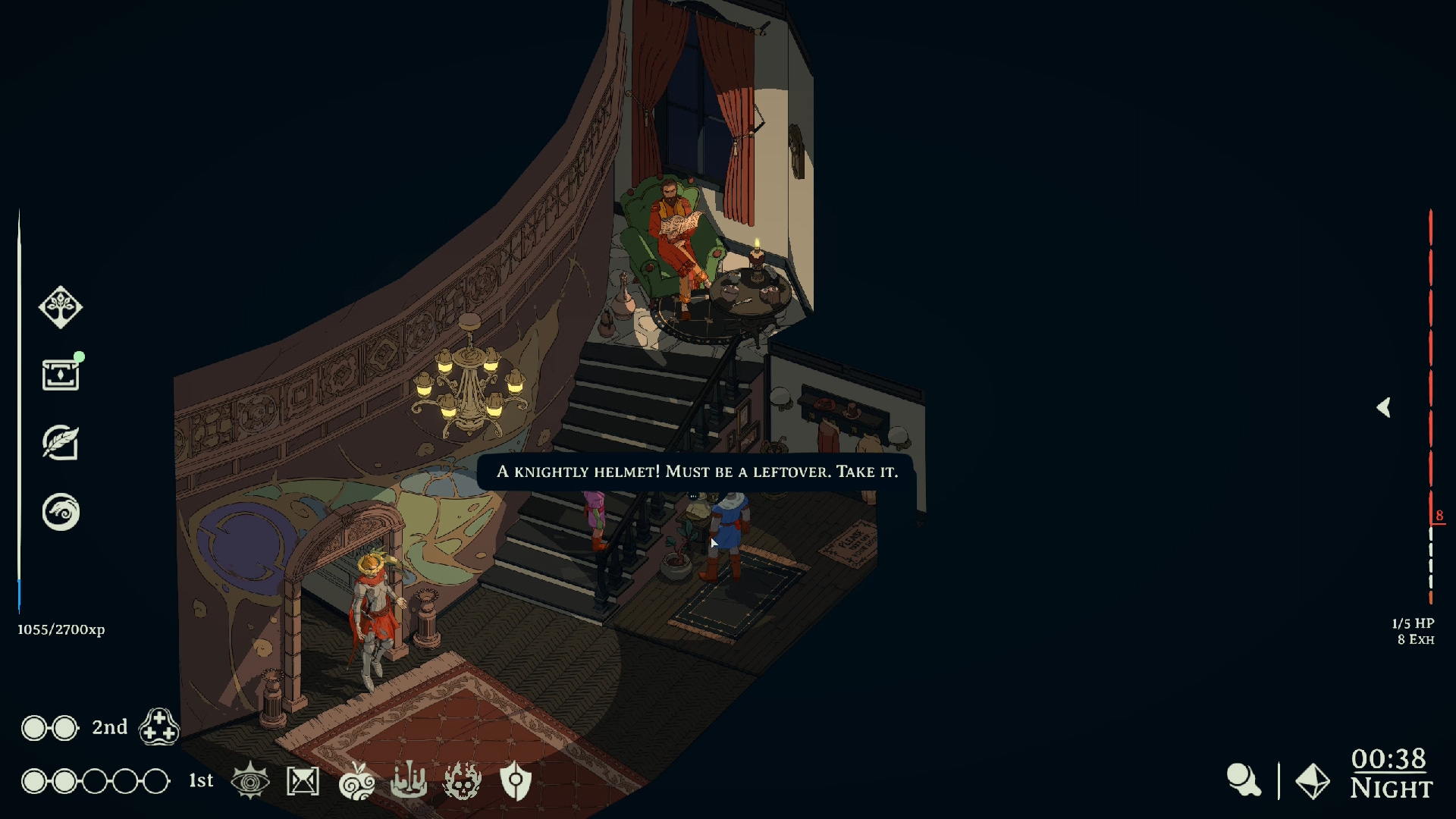
Shops mostly provide things you could just steal and exorbitantly priced consumables you won’t need anyway. The only real worthwhile purchase I saw, besides a few story-related costs, was for permanent stat boost potions [don’t worry, they’re all diluted to only last a week, conveniently, so despite your character ending the week as a demi-god they’ll presumably return to just moderately overpowered and insanely wealthy afterwards] and the shop that sells those just tells you the names, not their effect. So you have to savescum to find out unless you’ve already found one.
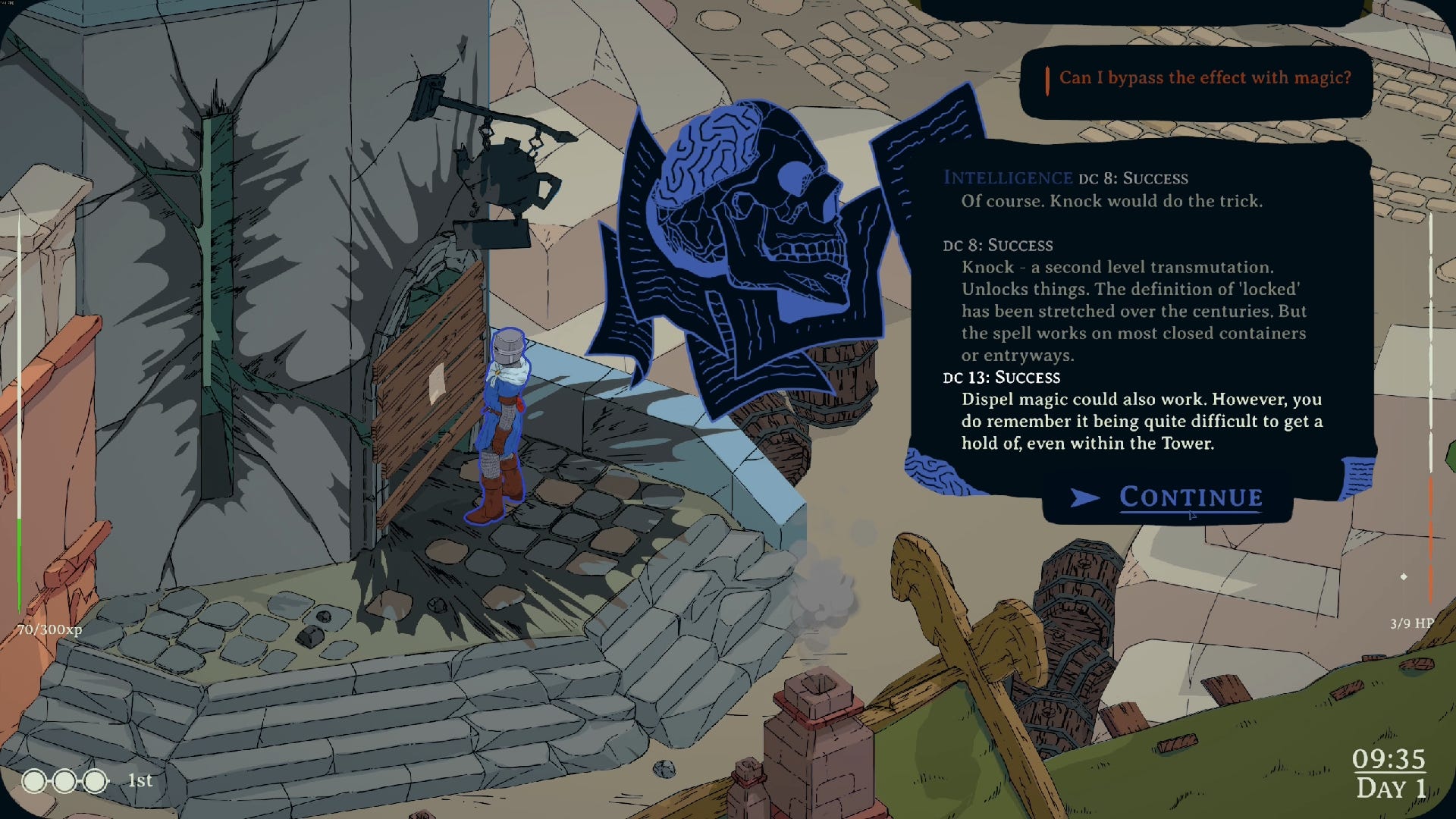
A lot of perks and items and spells and bonuses in general just give you Advantage1 in rolls against certain things or character types, some of which are highly specific [fine as a joke] but frequently also overlap, leading to no real benefit. And the spells themselves are kind of underused – while there is some combat, it’s not in the vein of a ‘real’ isometric RPG, so there’s no ‘drop a barrel weighing 3 million pounds on a dragon’s toe’ style tricks for you to experimentally discover, and aside from spells that let you talk to animals and corpses and read untranslated books, you really won’t get a lot of use out of the few that are available. For a game that’s almost all about being clever about the rules and fine details of how magic works in the setting, and the way your Cleric can learn to manipulate the very fabric of reality in different ways, you sure don’t get many interesting spells or things to do outside of facilitating further conversations. Although I will give the game a bonus point for giving Grease an actual use case that made me chuckle aloud.
The biggest disappointment for me was that there were a few scenes and locations that just did not seem finished, and so take place entirely in text against a black background. It’s not that I have anything against purely text-based games, and it’s not as though Esoteric Ebb is a particularly action-heavy spectacle even in the best of times – most ‘action’ scenes consist of simple transitions to different pre-set animations, and not a lot of direct translation of the details conveyed in the text anyway. But it’s something, and so it’s a lot more obvious when there’s just fucking nothing. There’s an entire portion of the undercity you go through that is just text boxes over a black screen, including an optional fight with a horde of skeletons. Not shown: the horde of skeletons I’m apparently fighting.
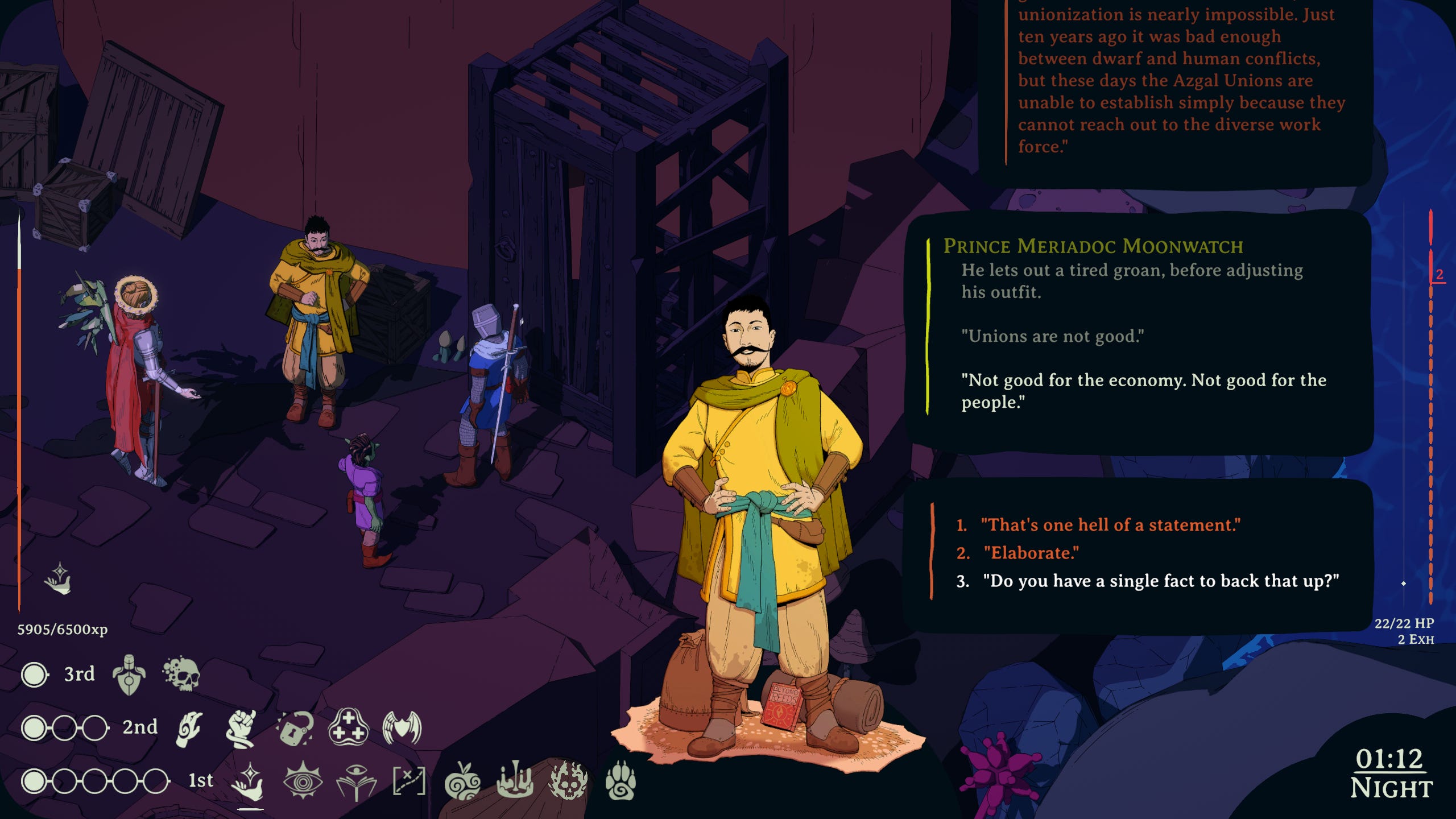
Finally, while I do find the writing to be above-average and more than good enough in general to not be grating over the course of a ~15 hour game that mostly consists of reading, it’s not perfect, and in particular it occasionally feels a little too railroady. Though the game does have a good amount of flexibility and gives you multiple viable routes to ending the game and even completing most side quests, there are a lot of spots where you can definitely feel the developer pushing you too obviously onto a particular track. Some of it can be excused with the fact that the Cleric is, despite the pretense of character creation at the start, technically not a blank slate, but even then, the times where you’re basically given four different ways to say ‘yes’ and at best one way to say ‘no’ do feel like filler.
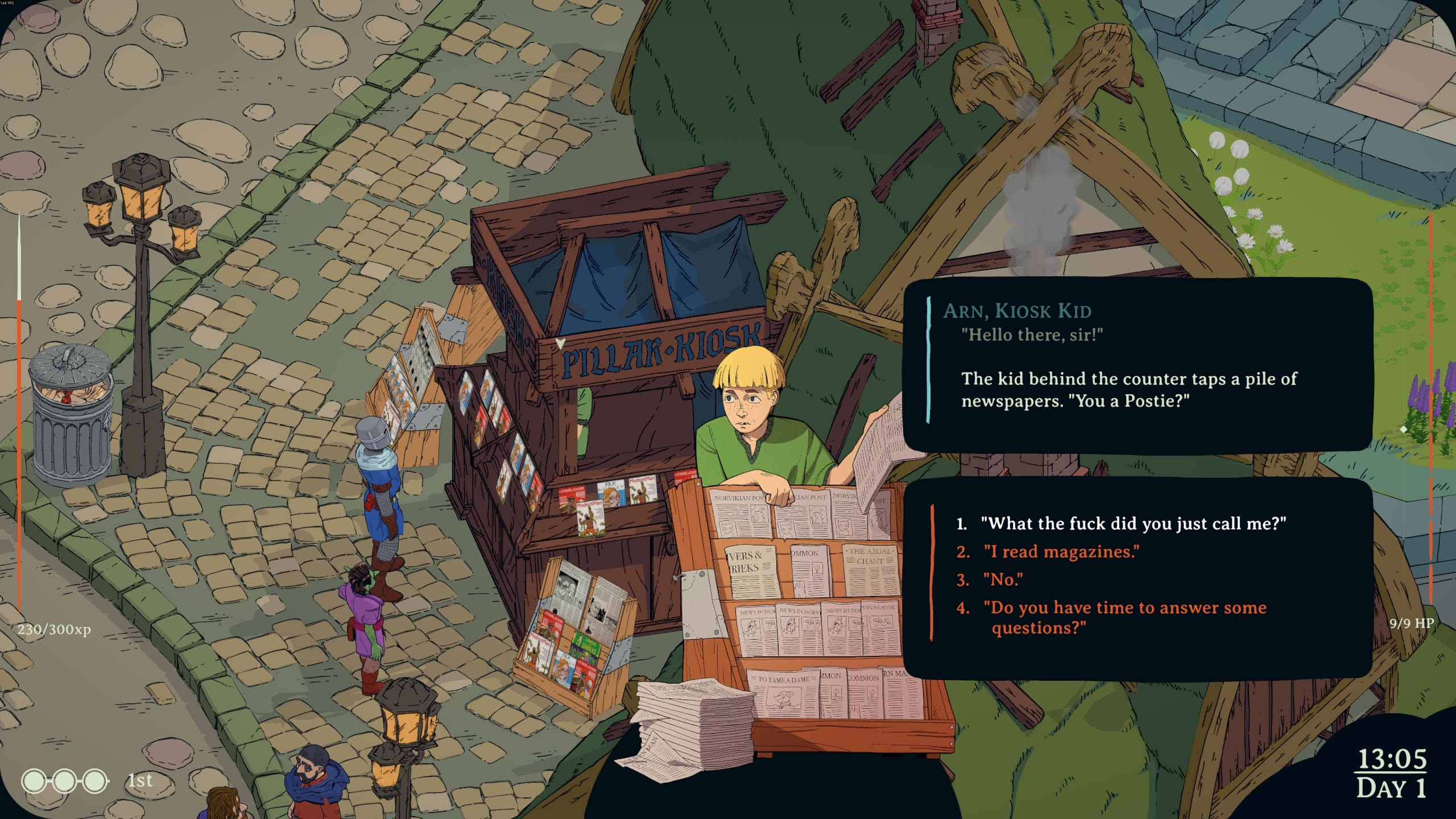
I’ve done my best to avoid spoilers for major plot points, funny interactions, specific creative item uses, and most of all, the genuinely effective emotional beats, because I do think it’s worth discovering them on your own, and they are part of what make Esoteric Ebb worth playing, and even replaying. For all the ways I feel compelled to compare and contrast it with Disco Elysium, I think the biggest compliment I can give Ebb at the end of the day is that I think it more than holds up on its own outside of Disco’s influence. It takes elements and enhances them, it takes flaws and corrects them, and it iterates without slavish imitation. It’s also a game that kept me engaged until 3 AM [real or in-game time?] grilling a halfling about the philosophical, ethical, and legal implications of Detect Alignment. It may never have been made without Disco’s inspiration, but whether or not you enjoyed or even played Disco Elysium, I think Esoteric Ebb is worth checking out anyway.
Esoteric Ebb can be purchased on Steam.
The ability to roll twice and take the highest result
Looks like it's in my wheelhouse. Added to the wishlist.
Esoteric Ebb is great! I’ve been enjoying it quite a bit