
Thief Gold
Call the storm, call the gray, bringsie back world’s old games.

Thief: The Dark Project sits at a critical turning point for first-person gaming – released less than a month after Half-Life, it continued Looking Glass Studios’ pioneering creation of immersive, fully 3D settings that defined PC gaming in the late 90s. Ultima Underworld and System Shock had already given the industry a new bar to clear, and as other studios began following that path, Looking Glass unleashed, over just three years, three of the best games ever made. Thief, System Shock 2, and Thief 2 are so good, so timeless, and so important that their release caused the studio to collapse and dissolve, like a shonen character who sacrificed every ounce of their vital energy in one desperate attack that changed PC gaming forever.
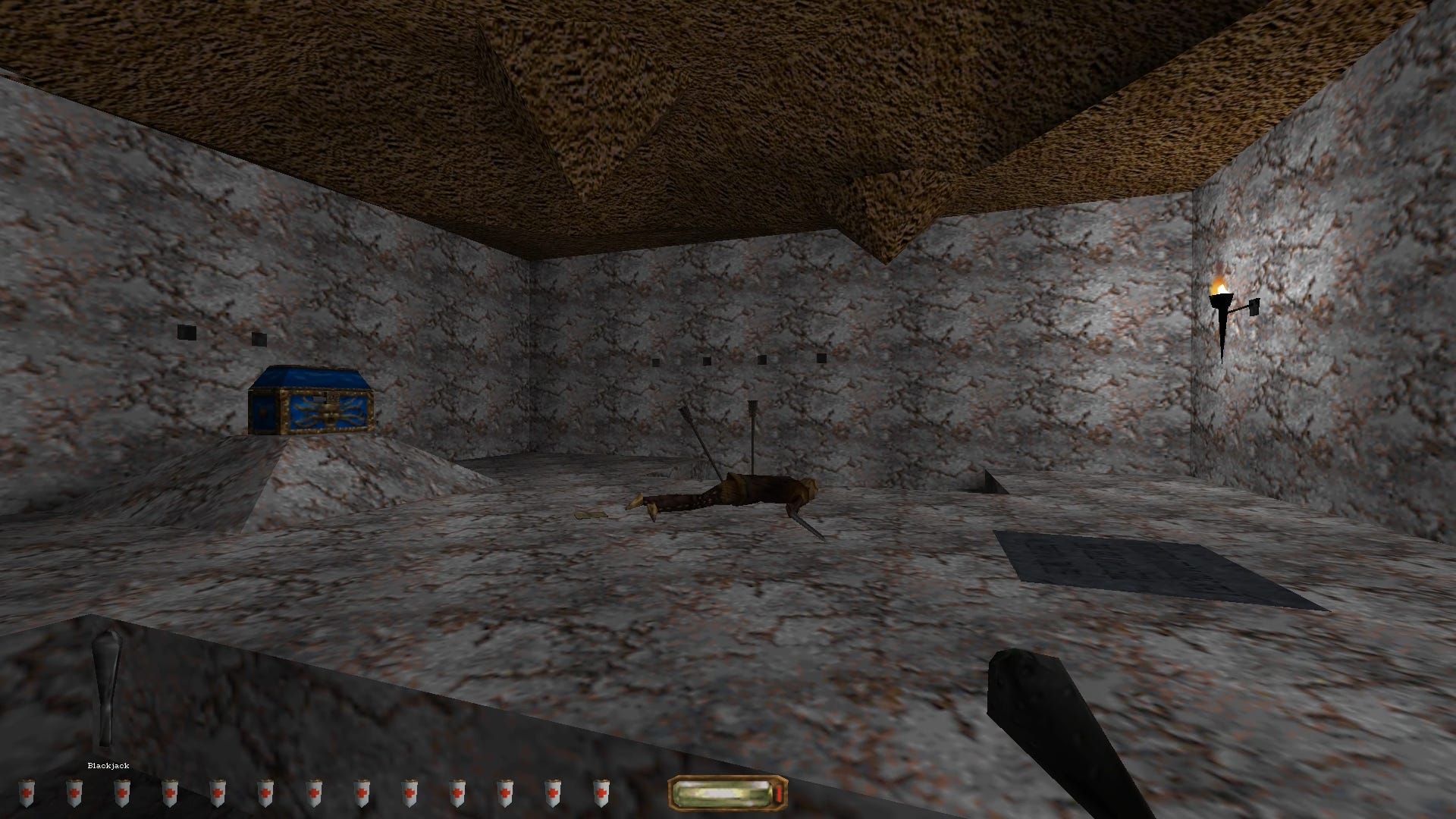
In Thief, you play as Garrett, a freelance burglar, formerly associated with the shadowy Keepers, who makes the rent by robbing his way around the city [called, simply, The City] he lives in. Now on his own, he takes jobs for fences, finds himself increasingly at odds with the more organized underworld, and eventually catches the attention of some seriously ominous clients.
What the game’s setup lacks in naming sense it makes up for in spades with atmosphere. The City is a mix of medieval urban sprawl and steampunk mechanisms, stone-block and wood architecture augmented with metal piping and gas lamps. The mystical and mechanical merge and compete, with mages still working primal elemental magic into usable crystals [which Garrett can attach to arrows for various effects] but increasingly displaced by the marvels of technology. Meanwhile, the citizens span the gamut, from homeless wretches pitching camp in the spider-infested caves beneath, criminal gangs claiming public sewage systems as their lairs, to the wealthy merchants in their palatial estates and religious orders worshiping in cathedrals rich with art.
The game is divided into distinct missions, each taking place in a single enclosed map, and filled with guards, monsters, loot, and a handful of key objectives. Most missions, as you might guess, primarily require you to retrieve some object, then make it to your extraction point, and the path you take and pockets you pick along the way are up to your discretion. Between levels, you have an opportunity to purchase some gear with all that discretionary loot you collected in the prior mission – arrows of all kinds, flash bombs, land mines, tips from informants or fences, and so on. You also have three difficulty levels to choose from, which affect not only the minimum loot threshold required for completion and optional objectives progressively tacked on to your assignment, but also some additional restrictions, usually a moratorium on outright killing.
Even when you’re not outright forbidden from taking lives, it’s generally preferable to move quietly, as the melee combat is pretty unpleasant. You get a sword, and most enemy types will go down to a few swipes even when fully alert, but reading their movements and not getting hit in turn is difficult, the noise tends to draw more foes, and it just takes longer than avoiding them entirely or dispatching them with a single well-placed blackjack blow. Thankfully, this is a rare stealth game where the stealth is actually good.
There are two factors in avoiding detection – visibility and sound. Your visibility is conveyed at all times by a ‘light gem’ at the bottom of the screen, brightening up in relation to how well-lit the current location of your body is. Beside the gem is a smaller indicator that lights up when you’re considered ‘visible’ from a distance, but the smaller graduations let you tiptoe closer to a transition point carefully without giving yourself away accidentally. So long as you’re in near-perfect darkness, even the most alert guards will walk right past you and any corpses you’ve piled in the inky night, as long as they don’t literally trip over you.
The game’s handling of sound is even more impressive. The most important feature is sound propagation – the sound effects played to the player aren’t simple bubbles that change the volume on distance and direction, but have to reach ‘paths’ between rooms. That means that footsteps from the next area actually sound like they’re coming from the doorway, and are even muffled if the door itself is closed. Every sound also gets modified by the surface it’s happening on, and this is worked into the level design in clever ways. Low-end or utilitarian spaces floored with wood, dirt, and stone are all pretty medium loud, while the elite residences where the good loot is hidden tend to have extremes of plush carpet and absurdly resonant marble tile. Each room even has its own acoustic properties, causing sounds to echo more in a big, bare space. Guards tend to be quite noisy by default, constantly coughing and muttering while patrolling, which helps you identify where they’re going, keep track of their numbers, and not bumble into them as often as you would otherwise.
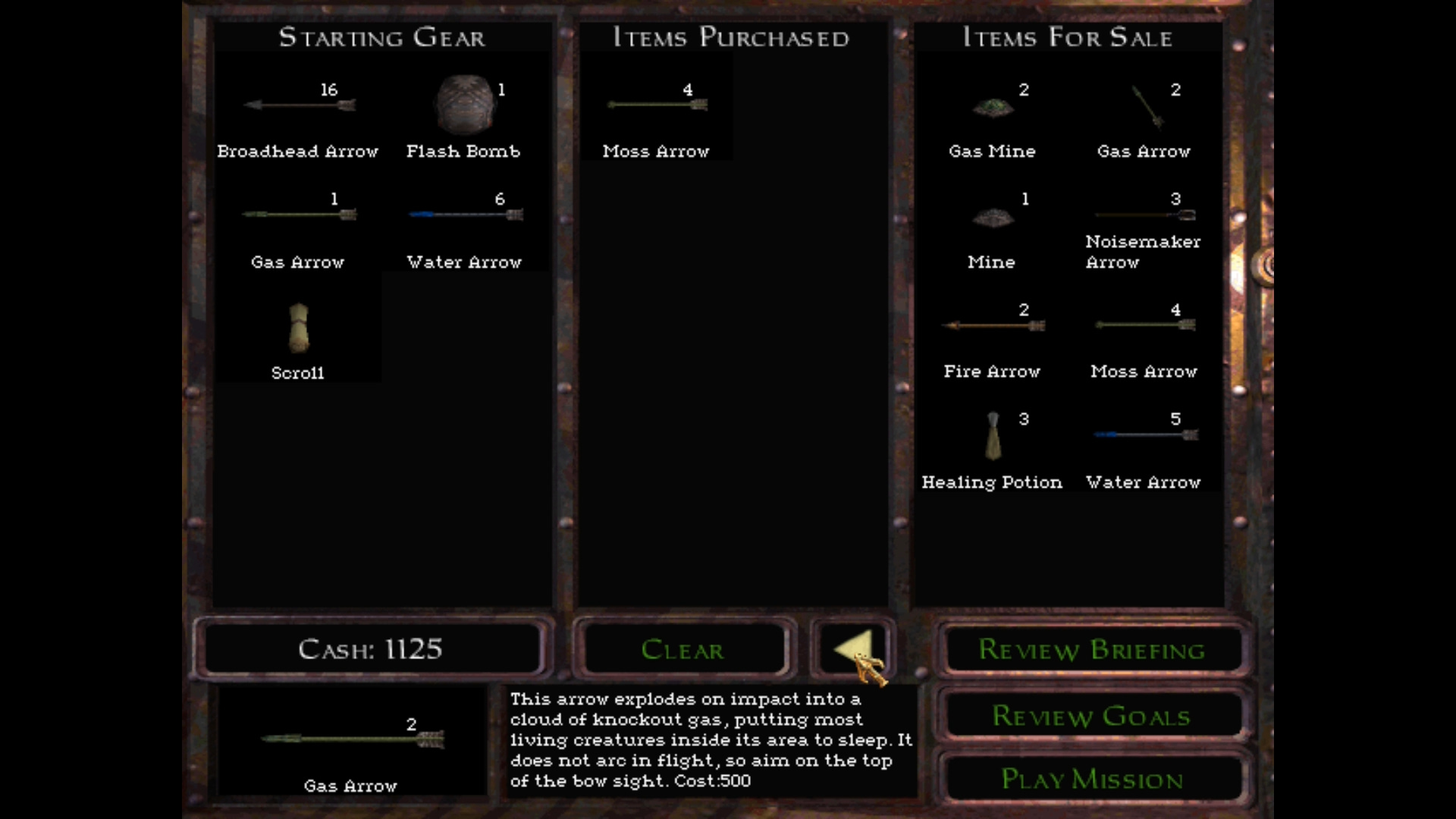
A huge part of the gameplay is in adapting to, exploiting, and modifying those properties. Water arrows are almost entirely useless aside from dousing torches… which makes them among the most critical tools at your disposal. Loud floors alert you better to patrolling guards just as they give you away, and a moss arrow can create a patch of permanently silent cushioning for you to stalk around on. You can use special noisemaker arrows, regular arrows fired into a hard surface, or just trash like empty bottles and dinner plates thrown around to distract someone looking where you don’t want them to. You can even fire grappling ropes up to wooden beams to climb your way up to another floor if you’re crafty and observant enough.
All these mechanics, neat as they are on their own, would be wasted if the missions themselves didn’t take full advantage of them. Thankfully, the level design is among the best ever made. The very first level sets the stage beautifully for the rest of the game, without feeling like anything but a perfectly believable little heist. Later missions elaborate on those themes and add more variety to the hazards and objectives but all continue to build on the idea of exploring a large, open area, combing through it for loot while avoiding or neutralizing whatever’s guarding the place, and escaping.
Almost every mission is extremely memorable – infiltrating a prison via a haunted mine, exploring a sprawling, booby trapped mausoleum one night, and then an ancient city that has sunk into the magma a week later. One of my favorite missions has Garrett pose as a Hammerite novice to enter a cathedral that’s active and guarded night and day, casing the joint until he’s ready to crack some heads and grab the gold. Another starts with you barely escaping assassination, tailing the bastards as they lead you to their employer, and then picking their boss’s pocket out of spite while clearing his house of valuables just to leave a message. And the plot is paced out just as wonderfully alongside the gameplay. Early missions are straightforward, contained jobs, building off each other naturally and believably to bigger things. You eventually impress a patron enough to land a serious gig, which takes up most of the second half of the game, as you collect MacGuffin keys required to land the big score, and then the final levels have you dealing with the fallout of that job.
Each mission is introduced with a cutscene, and these are some of the best setups in gaming history; simple, restrained, but still incredibly evocative and informative. The majority of them are just narration over top of still images, yet they still convey, in only a minute or so each, a richness of backstory, tone, and setting beyond what modern games accomplish with dozens of hours of mocap’d actors and half a dozen writers.
And speaking of narration, this game simply would not be the same without the voice of Garrett, provided by actor Stephen Russell. Garrett’s lines are, no equivocation, utterly flawless. Every word spoken, whether in a cutscene or in-game, sears the character’s personality directly into your mind, without a hint of overwriting or haminess. The resulting character is a perfectly epitomized anti-hero, not some annoying villain making a turn or corny criminal with a heart of gold. He comes across as cynical without constant sarcastic wisecracks, selfish and cold but not cartoonishly evil, principled without tediously expounding on his values. There’s fantastic voice work throughout by other characters as well, and the game would be worse off without all the hilarious guard conversations and such, but it’s Russell’s Garrett that steals the show. Of all the reasons I could say this game could ‘never be made’ now, that quality of writing and level of restraint in a videogame is high up there.
The first game was rereleased shortly after as Thief Gold, which primarily expands the scope by adding three entirely new missions to the middle section of the game, and rearranging some content from existing levels into those. I’d like to say it’s a straightforward upgrade, but honestly, it’s hit and miss. Of the three levels, I only actually like the last, find the second to be middling and disappointing, and I truly hate the first. Their inclusion also really dampens the importance at least of the Lost City mission, and I don’t find any of the other changes particularly interesting or essential either. But Gold is the way it’ll come on any digital platform, and though you apparently can downgrade the game to remove the extra levels, I don’t know that it’s worth bothering unless you’re really that curious what the game was like without Mages bellowing in your ear.
Sadly, even the base game has its flaws. As excellent as the sound design generally is, and as impressive as the technology underlying it is, there are still a bunch of things that are just balanced fucking wrong and will blow out your eardrums for no good reason.
A lot of the game’s level design requires you to get pretty good at the ‘mantling’ system, which is itself really impressive and is almost like Assassin’s Creed parkour in first person… in 1998! Well, except that, as you might expect from a game of that year, it’s kind of stiff and inconsistent – you absolutely need to be moving and looking almost perfectly perpendicular to the edge of the surface you’re trying to catch and climb up when you hit it, and if there’s some kind of bump or it’s just hard to see, you’ll slide off without knowing what you did wrong even if you know how it works, and the game doesn’t explain it in sufficient detail anyway. Stealth games like this tend to force you into savescumming anyway, but any time I’m expected to do something more strenuous than walk up a staircase in Thief I reach for the quicksave hotkey.
Enemy AI is pretty stupid, leading to guards that seem completely deaf, dumb, and blind right up until the moment you accidentally touch an invisible trigger, causing a guy to leap out of his bed and slam his sword into your neck literally mid-snore. Like most stealth games, even on max difficulty, unless you’re imposing your own restrictions and trying to ‘ghost’ every level, the stealth that the game hinges on can be trivially and, honestly, pretty quickly disassembled just by bonking guys when you get a chance and stacking them up in a nearby corner. Later enemy types don’t really improve the situation, aside from Hammerite Haunts – zombies shuffle around kind of ineffectually and can be chopped down to render them harmless, beastmen are pretty bad at combat and can be murdered easily without any stealth, and there’s no real bosses or elite challenge to overcome. Even the Hammer Haunts mostly just act as guards you can’t blackjack and can slay you easily in a direct fight.
Some of the missions are genuinely annoying to navigate, making it even worse when you miss an objective or can’t find the way to proceed and wind up having to go back and forth multiple times. This is epitomized in the worst of the Gold added maps, which has you crawling back and forth through a sewer network to get keys, open drains, and scrounge up loot. Speaking of loot, I played through the game this time on Hard, and not Expert, and it’s not because I don’t like a challenge. Now, I always love a game differentiating difficulties in interesting ways, and Thief does just that, and commendably. What I don’t like are the increasing loot quotas, which outright prevent you from finishing a stage if you haven’t found quite enough little baubles on top of hunting down whole extra secret areas and avoiding murder.
The last time I did a replay of the Thief games, I did so on Expert, and in too many of the missions it just wound up tacking on at least another 20 minutes of bullshit, looking under beds, jumping like a little kid to see what’s on an out of reach shelf, squinting in dark rooms trying to find the last few FUCKING coins or whatever so I could move on, and I swore by the end that I’d never put myself through it again. It really isn’t that much harder anyway, you can avoid killing guards with a bare minimum of self-control, and being FORCED to collect more money while also incentivised to hoard resources is just ass backwards, in the way of Demons Souls making healing items drop more often if you don’t die frequently.
But for all my complaints, nothing can really tarnish the magic of Thief. While it may show its age and occasionally be even rougher than you remember, it remains the best of its type, outshining more modern attempts to emulate its innovation. If you’ve never actually played Thief, you must, at your earliest opportunity – it’s not just a fantastic game in its own right, but one of the most essential experiences in gaming. Even if it’s just been a while, it’s probably been too long.
Thief Gold can be purchased on Steam and GOG.
I loved this game, and pretty much everything done in this style (System Shock, Deus Ex, Prey, etc.). I seem to recall the mechanical men being part of some Thief 1 missions, but I could be remembering them from Thief 2. Enemies that were immune to everything except for water arrows hitting them in the middle of the back where the burner was.
Great game and great write up. Downloading it tonight. I fell backwards into this game when it came out - had no idea what to expect - and was just blown away.
I played through Thief 2 and remember liking it a lot, but feeling like it was bigger and more complicated without being better. I remember not liking the (Druidic?) level very much for some reason, and that there were a lot of those.
Never tried Thief 3. The reviews made it sound meh.