
Starvester
Isolated 30 billion particles of exotic matter and all I got was this stupid t-shirt.

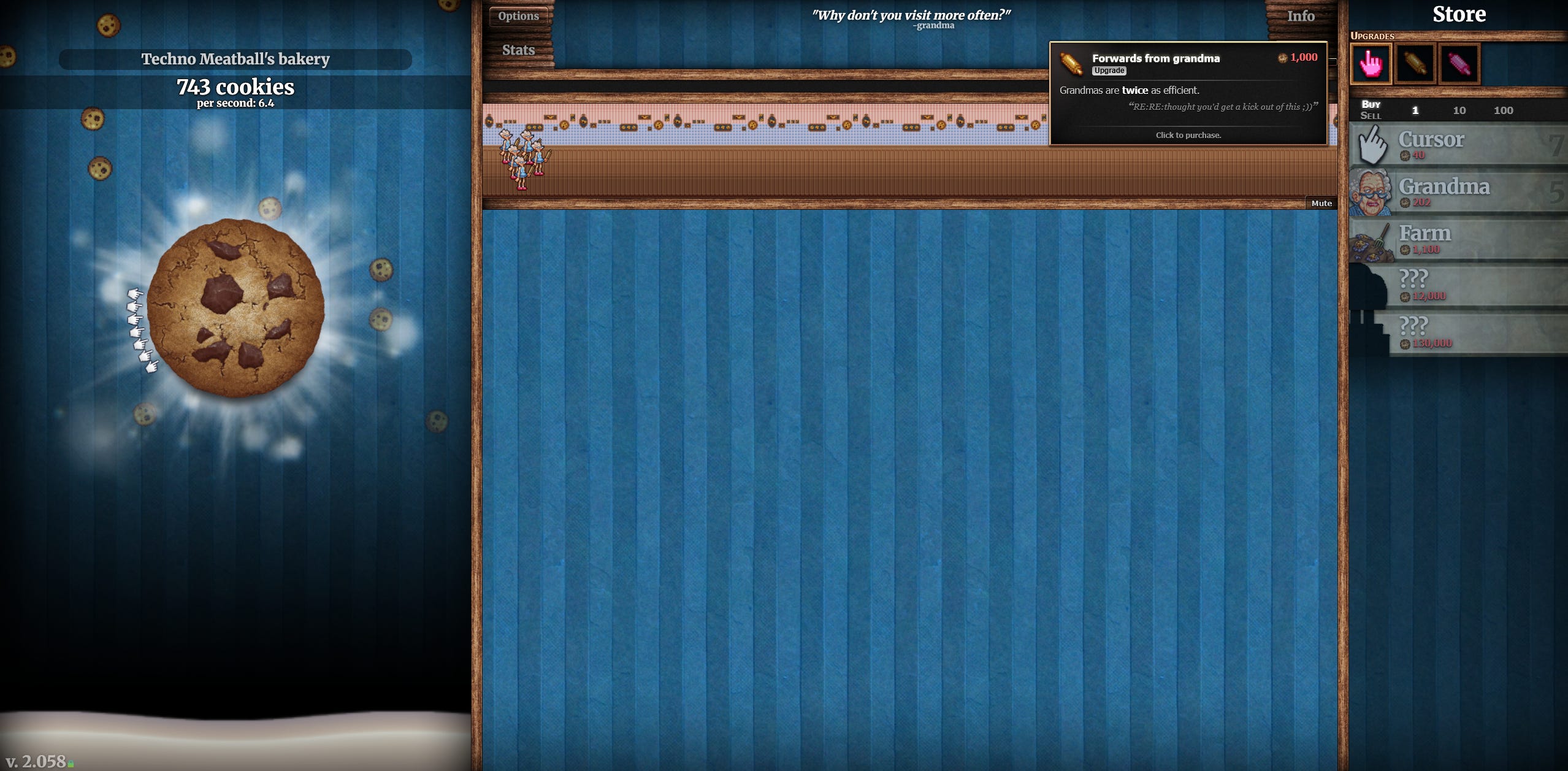
Of all the genres of games that maybe shouldn’t exist at all, perhaps the most obviously deranged are Clicker games. Epitomized by the bizarrely ambitious and auto-parodic Cookie Clicker, the subgenre thrives by embracing the absolute worst critiques of gaming as a whole – they are intentionally wasteful of time and resources, a circular construct made to offer the one reward present in all ‘real’ games: numbers that go up. Numbers that turn into other numbers that then compound your previous numbers until some of those numbers begin to be displayed in scientific notation, all so you can watch that number hit the threshold required for you to add another tier of exponential increase, making number go up again even faster. Or maybe you just strip all that down, give the player something funny or overtly stupid to click on, and mock everyone that expends even a moment of thought on it.
Starvester goes the other direction, and boldly asks: can this genre be fulfilling? Can it have a recognizable appeal and reward system? Can you make a clicker game that doesn’t just waste your fucking time? Well, kind of.
You begin Starvester, as with all clicker games, clicking on a thing to make a number go up, in this case representing Fuel. Once you click up enough Fuel, you can spend it to buy a Drone, then permanently assign a Drone to Vesta to collect Fuel for you. Eventually, you’ll get enough Drones pumping out Fuel that your clicks won’t even make a drop in the bucket, and you’ll unlock a new station that lets you assign Drones to a different task.
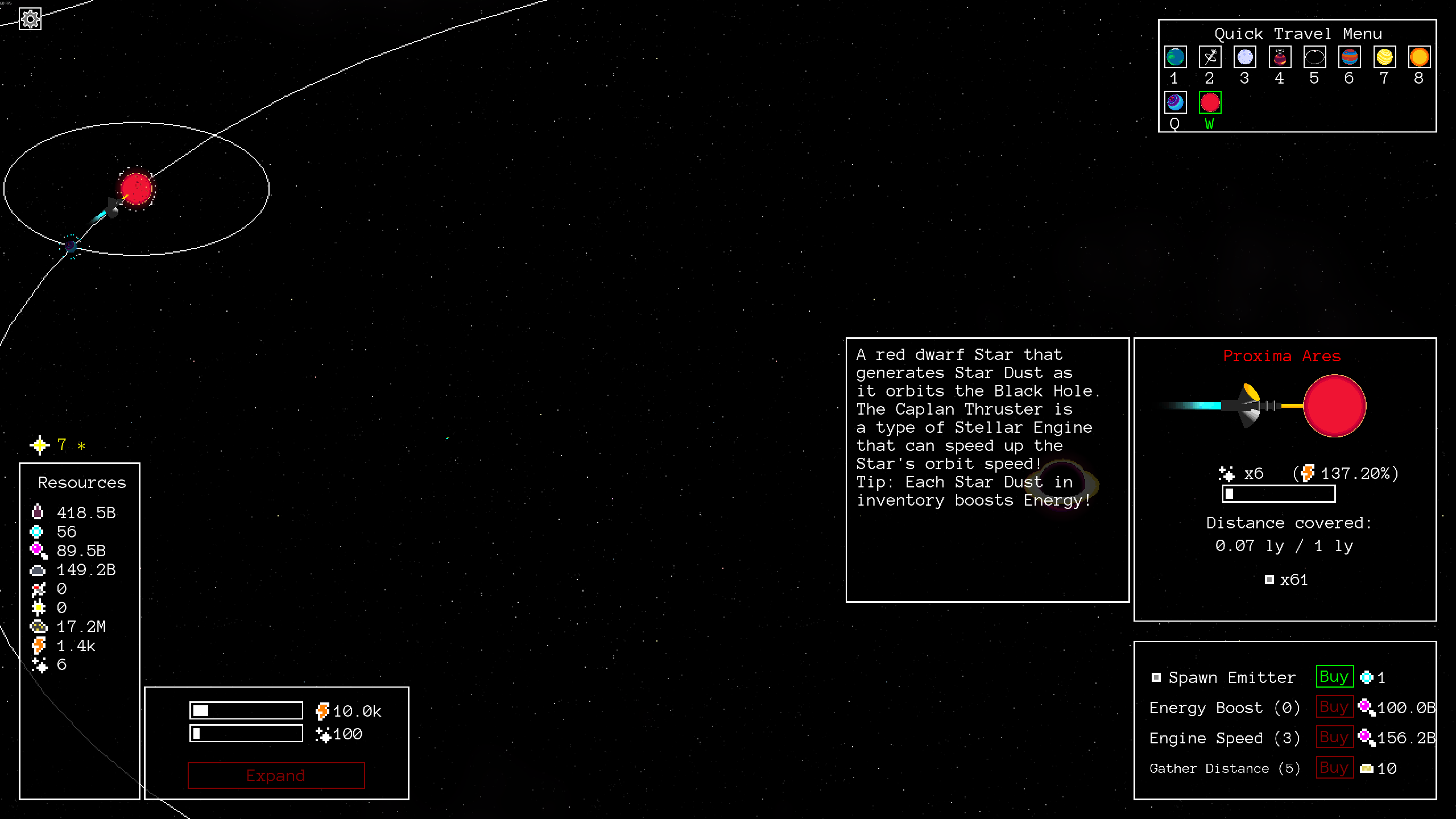
What makes Starvester stand out from the genre standard bearers is that the progression feels genuinely meaningful. First, by the scale and objectives – you start out mining basic resources to expand your reach, slowly seizing absolute control over every conceivable exploitable material within the local star system… and then beyond, each step giving you a wider view of the supply chain you’re building. You advance by unlocking new planets, moons, or stations, discovered by reaching some total ‘lifetime’ amount of base resources. [that is, you don’t have to spend anything to tier up] And each one of those new locations offers something a little different rather than just a straightforward increase in the number of virtual mouse cursors clicking on the Fuel planet.
One of the locations you’ll unlock is a gas giant that turns Drones into lasers, cooking off gasses that can be compressed and sent to any earlier planet to permanently scale its production levels. Another is a ring that glides around the local asteroid belt, launching remote mining Drones out to harvest ore, which can then be processed into ingots that passively improve collection rates of certain early resources – or refined further into even better materials that also augment other systems, like satellites or the ore production itself. The most crucial early system is the research station, which provides a currency that is used to upgrade every other outpost in multiple ways. Research can increase the speed and collection rate of Fuel drones, the gas generated by lasers, and reduce the cost of satellites purchased at the scrapping fields. It can also be used to compound its own production, and is one of the only resources that remains relevant throughout the game. Everything scales, so costs increase dramatically over time, but the next planet will inevitably give you an even sharper initial curve of return on investment, letting you ramp up productivity and outstrip costs again until you again reach the point where you’ll need a further paradigm shift.
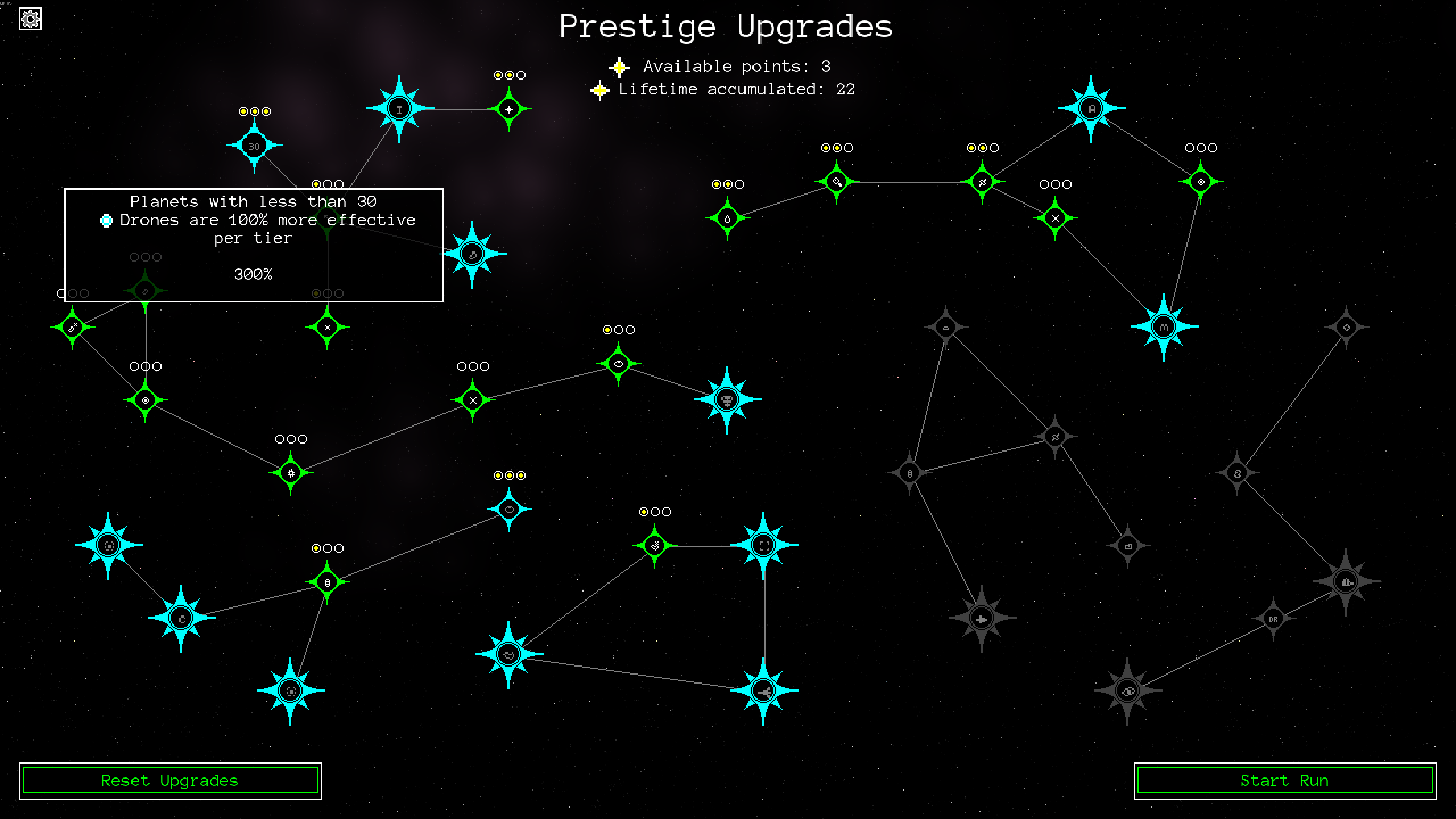
After you’ve unlocked the first couple systems, you’ll gain access to Cindermoon, which acts as a separate, meta-progression system. Cindermoon rewards you with prestige points after certain lifetime resource thresholds, and at any point, you can quit your current run and start over, clicking up Fuel to buy your first few drones again. However, between runs, you can use any prestige points you’ve earned to buy global modifiers in a skill tree, massively augmenting your collection rates, turning the first ten minutes of a run into ten seconds, and letting you hit the next couple caps without needing to leave the game running unattended for multiple hours. Smart use of the prestige system gives you an edge and then some, trimming the fat and giving you a reason to start over and reassess how you want to deploy your drones [which are assigned permanently and increase in fuel cost to prohibitive levels after the first hundred or so] for better value potential in order to hit your next expansion quota.
Eventually, you’ll strip out the asteroid belt, squeeze the gas giants dry, shake every drop of oil out of the dead rock you landed on, and surround the local star with solar energy stations, giving your terrifying drone swarm the power and ability to make the leap through interstellar space and start infesting a nearby system. This is where the demo left off, and unfortunately it’s where Starvester starts to go off the rails a bit. The systems become a little more convoluted, the progression slows down, and the game really struggles to keep the cycles interesting.
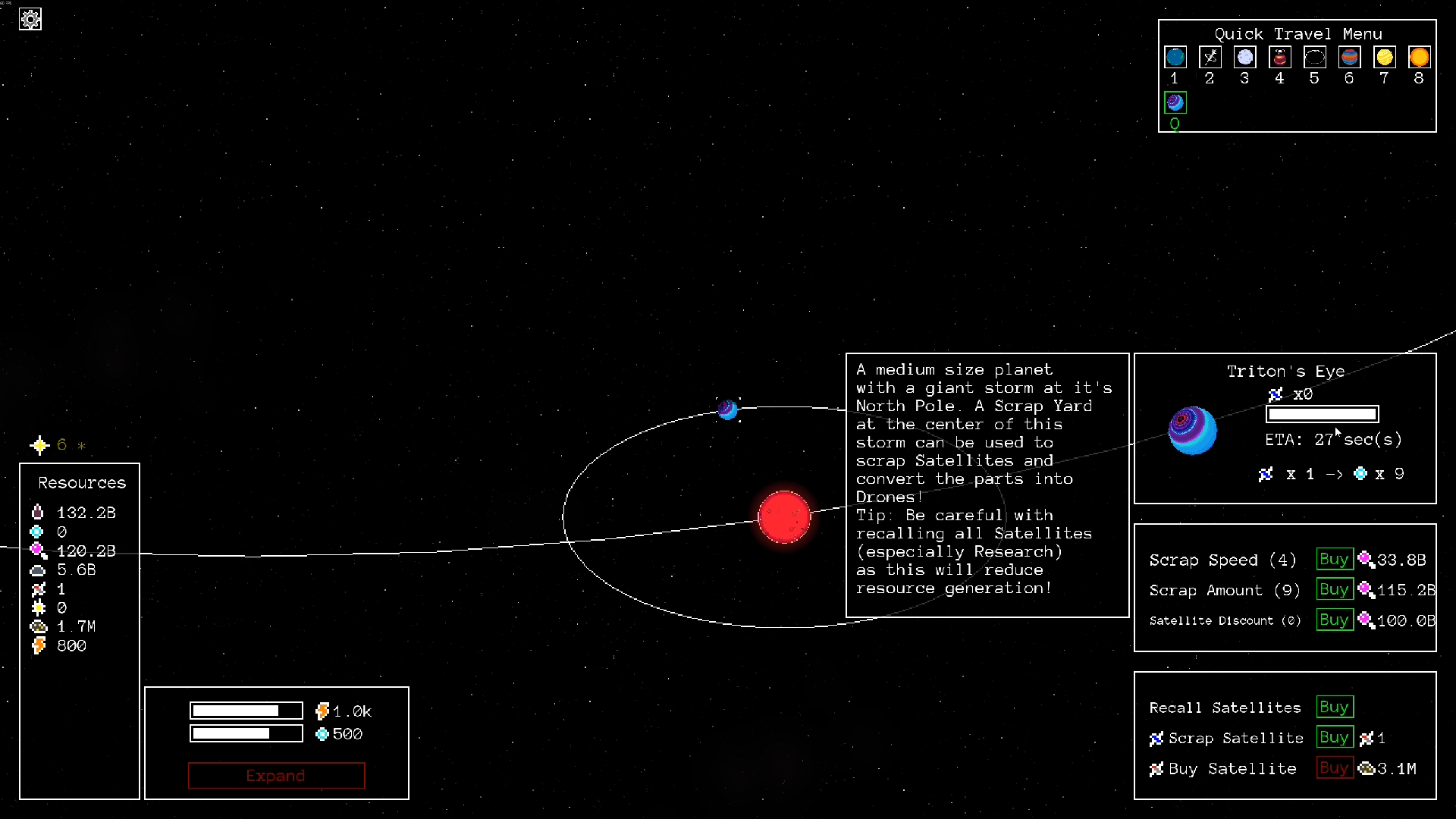
There are still some really neat ideas here – one late-game location lets you recall satellites being used to augment the first three resource types and reassign them, or start stripping them down into packs of Drones, badly needed now that each new Drone made the conventional way probably costs a cool trillion Fuel. Another uses a particle accelerator to collect antimatter, which you can fire at certain other locations to obliterate their drones in exchange for a massive boost in pure energy. One planet uses a wormhole to mine spyce from a distant [unseen] system, then can spend it to drive market prices on an interstellar exchange into near-infinite growth before cashing in on generating so much Research that you drive your totals deep into scientific notation land, producing the equivalent of a number of drones greater than the number of atoms in the visible universe.
The final big hurdle involves you building a ringworld around a star, populating it, and then working to scale your global birth rate to hit population thresholds needed to close the game out. It’s one of those pivots that looks a lot more complex and interesting than it really is, and probably the biggest letdown in the game, if I’m being honest. There just are not that many levers to pull to meaningfully improve things, the tier above it is just another set of linear scaling factors for exponential cost, and it all mostly ignores every other mechanism you’ve been working with up to that point.
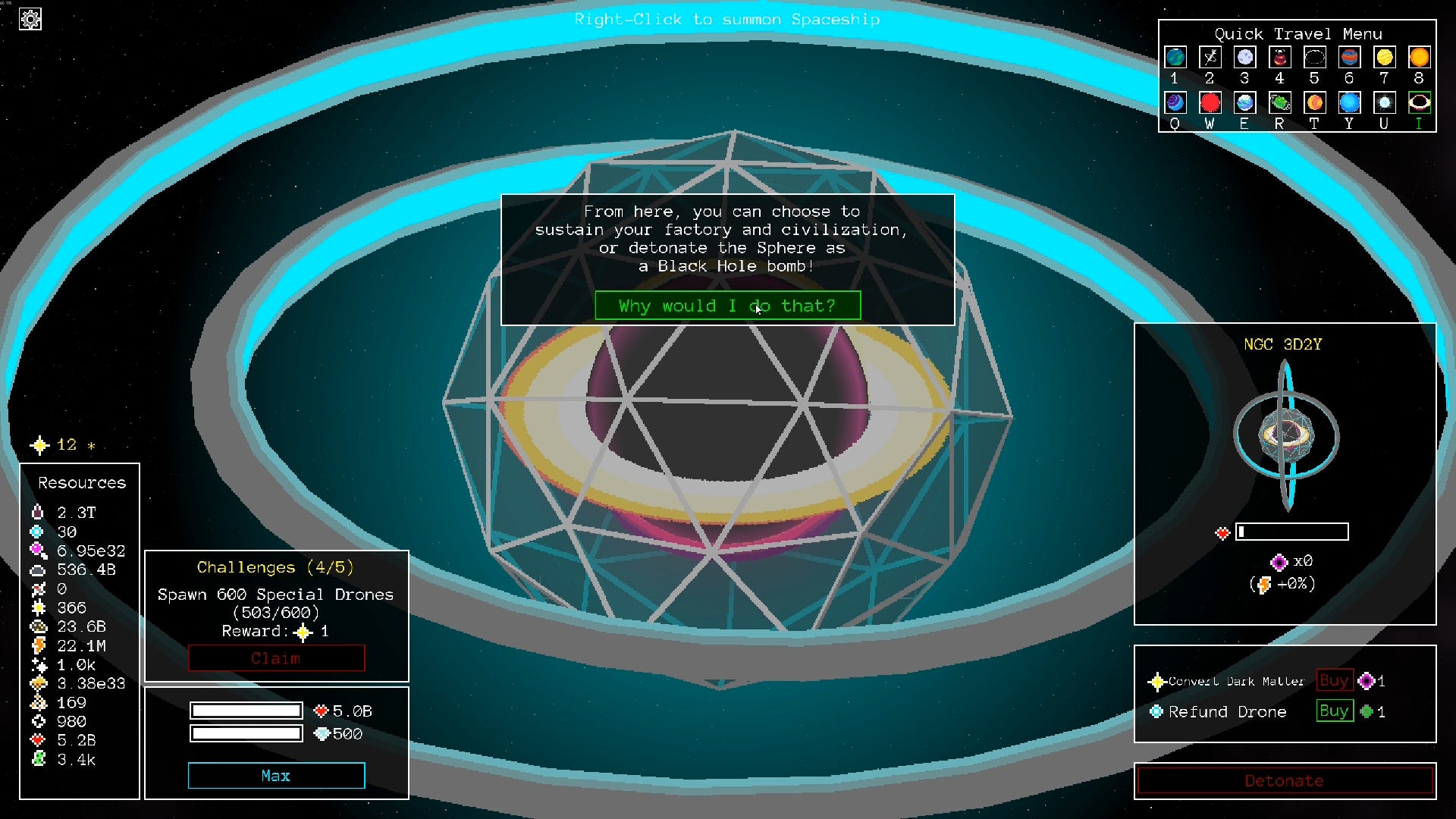
The ultimate reward is a full enclosure around a nearby stellar black hole, with which you can gradually accumulate extra prestige points [which you don’t really need at this point] or spend ten of them to detonate the black hole, obliterating all your work, with the promise being the birth of a new and different cosmos ripe for colonization. Which is a fine sequel hook, but isn’t as earned or impactful as the ending of Outer Wilds, for example. In fact, the ending itself is kind of muted and lame – I would’ve appreciated at least an animation of an expanding nebula or the formation of exotic stars as a little celebration for your achievement. The game as it is just... fucking ends. Come on. Give me a ‘CONGRATURATION but your dark matter is in another galaxy’ or something.
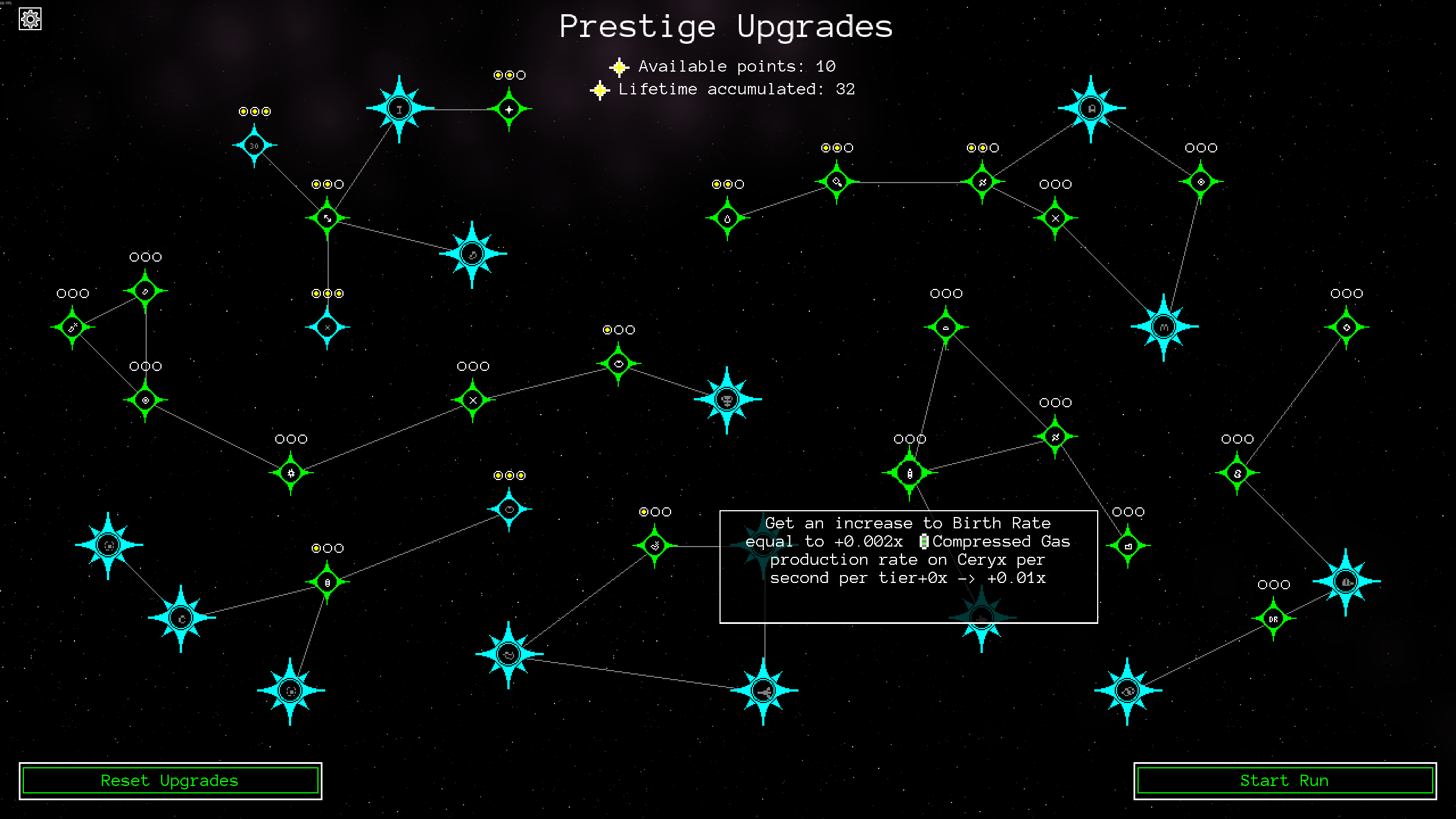
The biggest flaw with the back half of the game is that the prestige system falls apart entirely. It starts out really well, with you getting to freely reassign points each time you restart, boosting fuel production directly in the early stages, shifting over into research at all costs, picking a few conditional but powerful perks like 300% generation on planets with fewer than 30 total drones, and so on. Later on, more prestige perks get enabled by default, mostly consisting of quality of life options, like auto-creation of drones on the first planet every time you can afford one, sparing you from having to shuffle around as much once the research options on that planet are maxed out. However, some of the later ones just flat out skip to a certain level of progression, making you start with a bunch of different planets, and jump around dropping a handful of drones on each as you spin production up on like eight lanes simultaneously. Eventually you’ll just start with the ringworld open, which is mostly irrelevant as the ringworld and indeed much of the back half of the game just doesn’t contribute at all to the starting system.
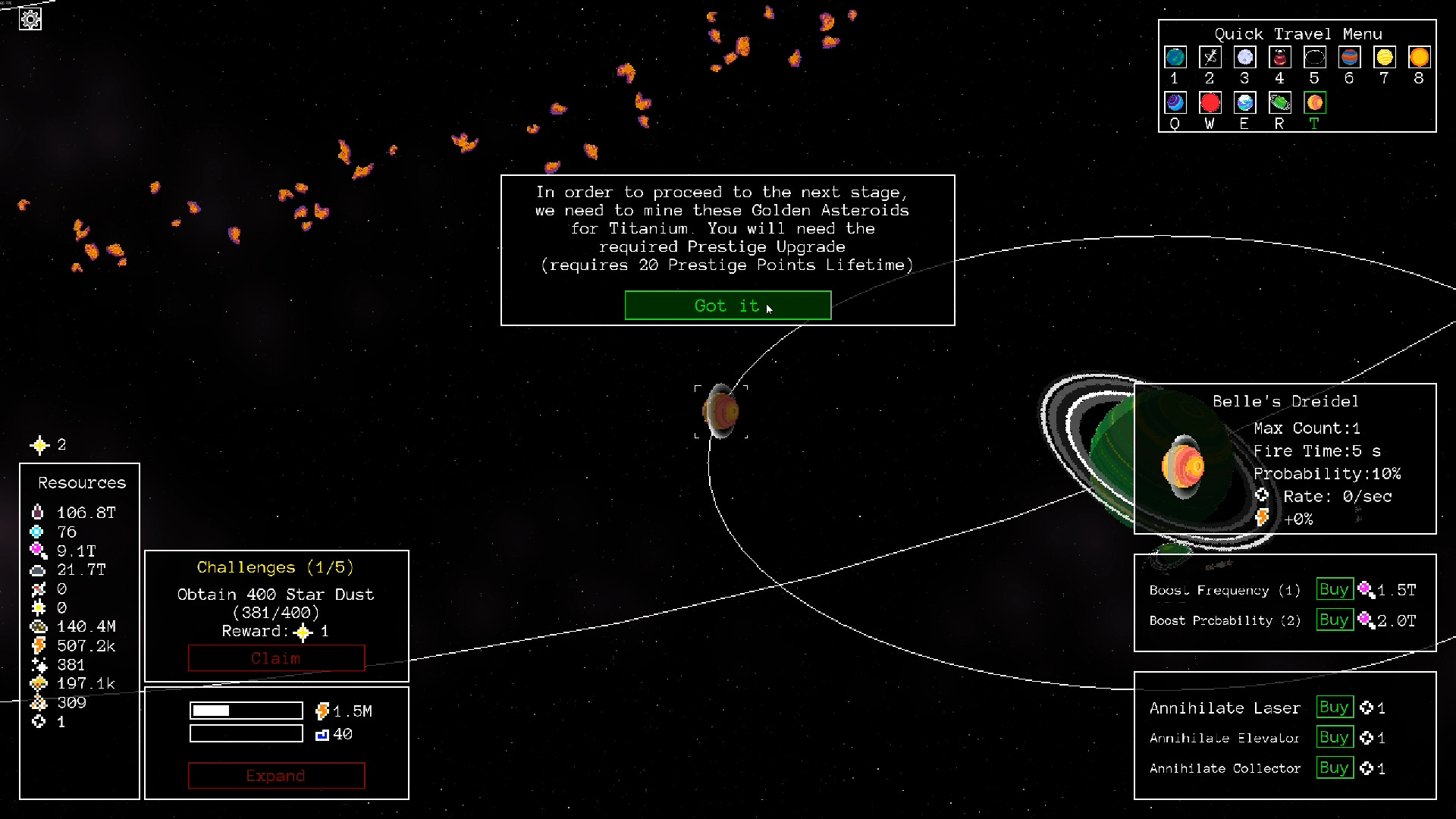
Worst of all, there are a couple spots where the game outright slams the brakes on you, requiring a particular perk from the prestige tree to progress any further, which is a little antithetical to the whole idea of the game, forcing your hand when you otherwise had played well enough to move on a bit further before a reset, and the ‘added’ mechanics these mandatory resets revolve around just aren’t that revolutionary or interesting on their own. This all could have worked better, with prestige options for accelerated starts, raising the max investment caps for early planets, maybe even altered function of some systems, whole new dynamics available for players coming in having already witnessed matter-antimatter annihilation, and so forth. Instead, it ends up feeling forced and arbitrary.
Another prestige perk enables a ‘challenge’ popup, which gives you discrete tasks to complete in order to earn further prestige points outside of the normal system, and, again, it feels like a system that could have been much better designed. There’s only a couple of them in total, most of them are just busy work or yet another quota threshold to hit, and once you’ve done them all, the popup window is just stuck on your screen with a greyed out ‘MAX’ button for all time. One of the things the challenge missions force you to do, by the way, is spot and manually click-mine a large number of free-floating asteroids, which spawn randomly, float by for a short amount of time, and give you a little bit of refined ore on destruction. This is the one sort of… break from pure menu management you get in the game, and again, it could have been a lot more interesting with a few tweaks. The last thing you unlock in the game is a little spaceship you can fly around, but its only use is to shuffle drones around to different stations – you could’ve used THAT to mine asteroids, scout out new caches or resources or even whole installations, fight off invaders, hell, fucking anything.
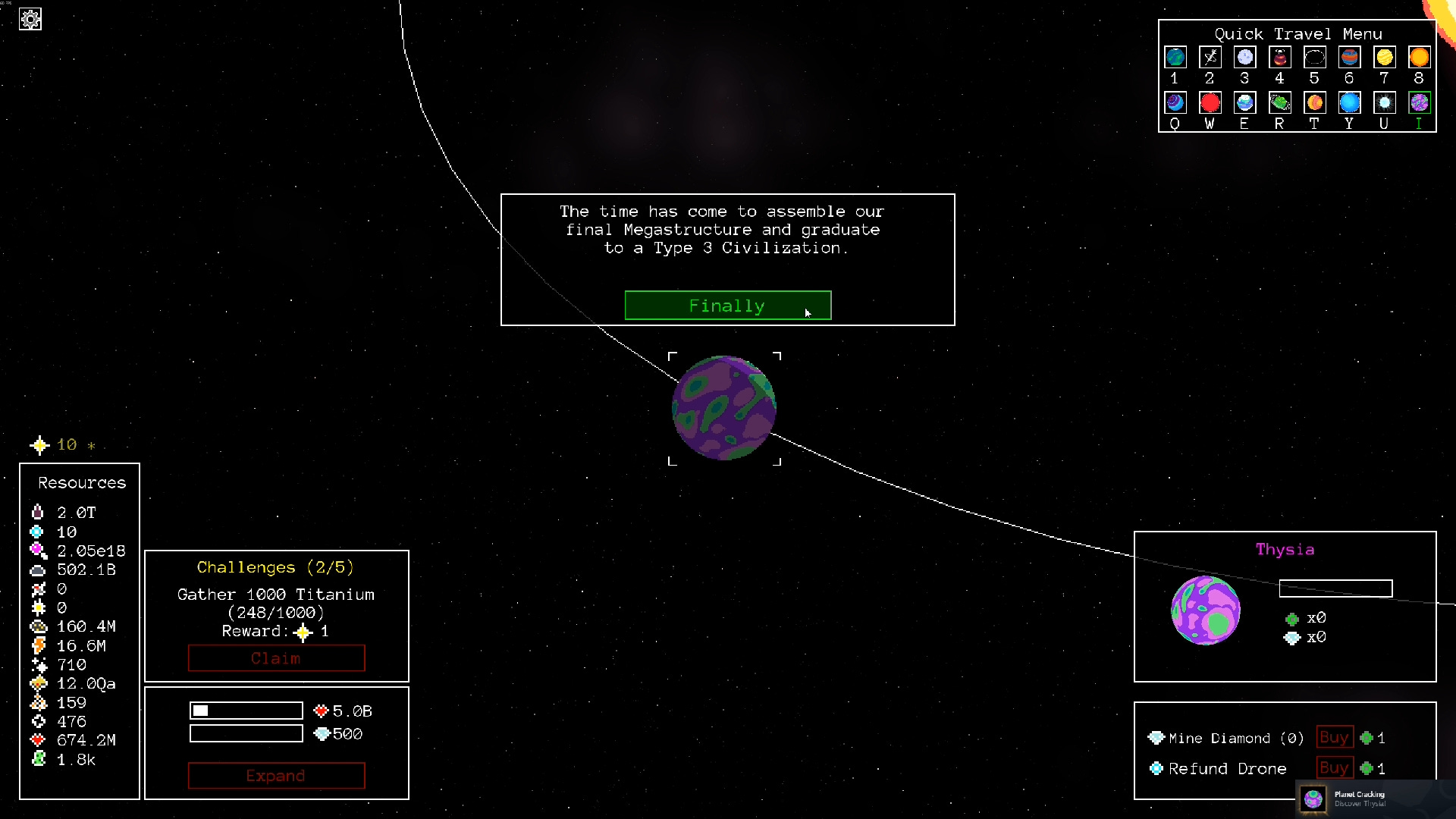
My last complaint is that the creation of the final megastructure [a Penrose sphere] includes the message that doing so will graduate your colony to a Kardashev scale Type III civilization, which very definitely exceeds what’s actually being depicted – extraction of energy from a single stellar-mass black hole does not compare, even as a small percentage, to the total emitted energy of a galaxy. Type II, sure, but stay humble. You’re just gonna blow it all up anyway, aren’t you? I liked most of the little relatively-hard sci-fi explanations for what each system was actually doing, but that one bugged me. A Type III civilization would be turning all matter in the observable universe into AI data centers so they could generate pictures of naked Touhous without learning how to draw.
As much as I’ve complained just now, I do think the game as a whole actually works. Its presentation is excellent, with the star’s-eye-view of the systems letting you zoom in to see dozens of flashing numbers indicating the work of hundreds of drones, tiny pixels zipping from place to place, massive swarms hauling resources astronomical distances, solar energy collected and fired in coherent beams to distant stations, with the pecking and chirping of individual drones fading into a relaxing musical background track. Aside from the very endgame, you generally won’t be forced to simply sit there and wait for numbers to go up very often, but in the few minutes of relaxation you do get, it’s nice to just zoom out and watch your mechanical locusts buzz around before getting back to work.
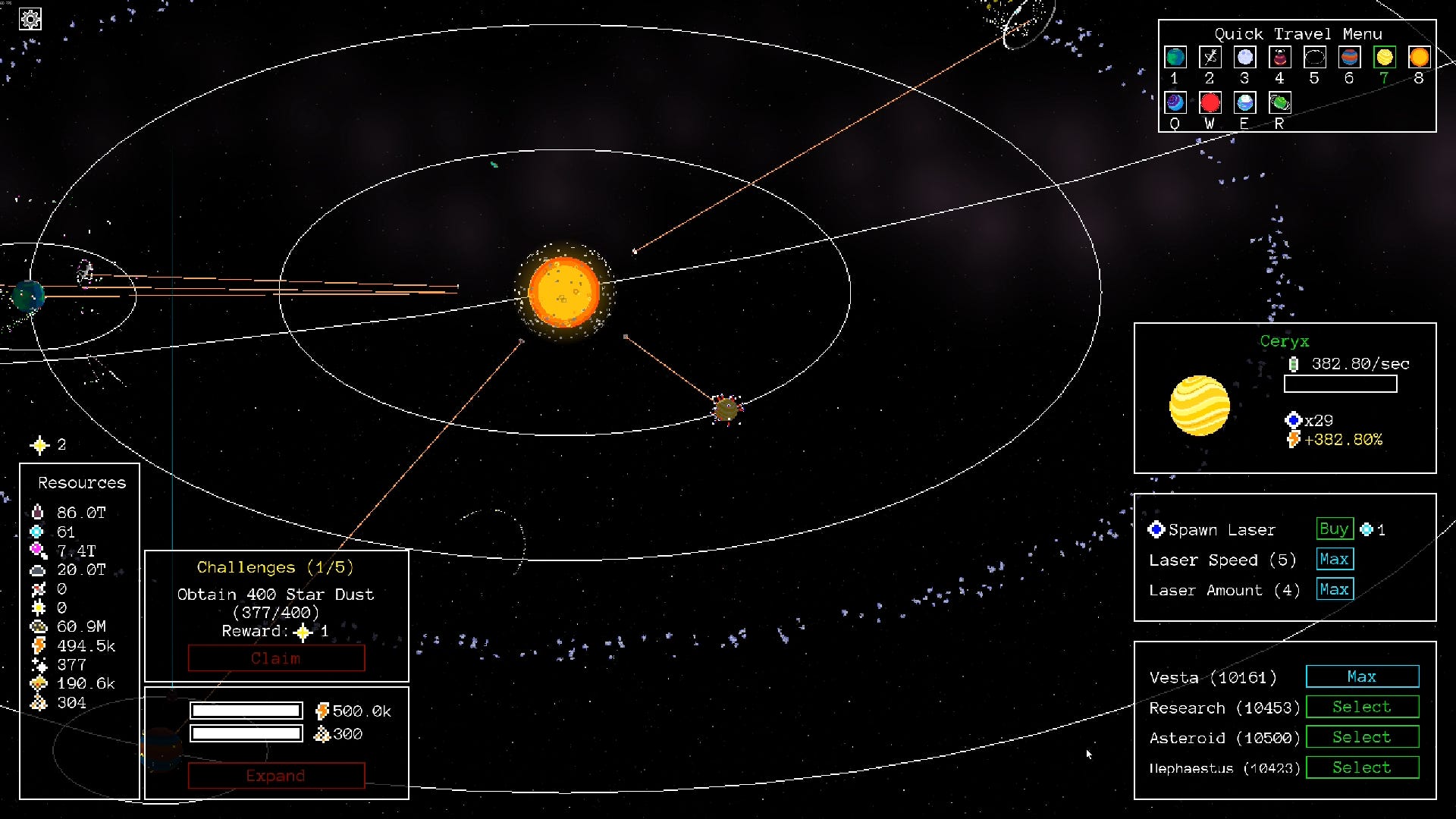
Starvester very nearly makes good on its conceit, and is easily the least vile and reprehensible clicker game I’ve yet experienced. It balances things out so you’re spending a lot more time actually pushing buttons and analyzing scale than you do simply waiting for processing cycles to cook off like you’re running protein folding simulations or mining bitcoin, but with even less to show for the real-world energy use. It’s to the game’s credit that I find myself so irritated by its flaws and failings, so desperate to point out what can be changed, what would make it more engaging, how I would do things differently, because it means it’s close enough to greatness to be worth risking a TILT warning for. The developer has already been tweaking requirements, costs, and so on in patches, but this is an inherently difficult sort of game to balance, and Starvester is an even more complex mathematical problem to solve than usual anyway. Hopefully lessons are learned and rolled into a future update or sequel that nails late-game progression better, because I think this is already a fantastic starting point, and well worth the couple hours it takes to beat.
Starvester can be purchased on Steam.
I don't really understand games like these. I played some Cookie Clicker when it released, but I bounced off it after a few hours. Nowadays, these games also don't work out too well for me because I have some lingering issues in my hand that make those repeated clicking movements kind of nerve suicide.
That said, this past year I tricked myself into buying two incremental games: Cauldron, which I did finish the main mode and found it sufficiently fulfilling because it's kind of a JRPG, and Horripilant, which got me mostly due to the art style and drained me of 6 hours of my life before I snapped myself out of it.