
Desecrators
GuideBot, lead me to the next game.

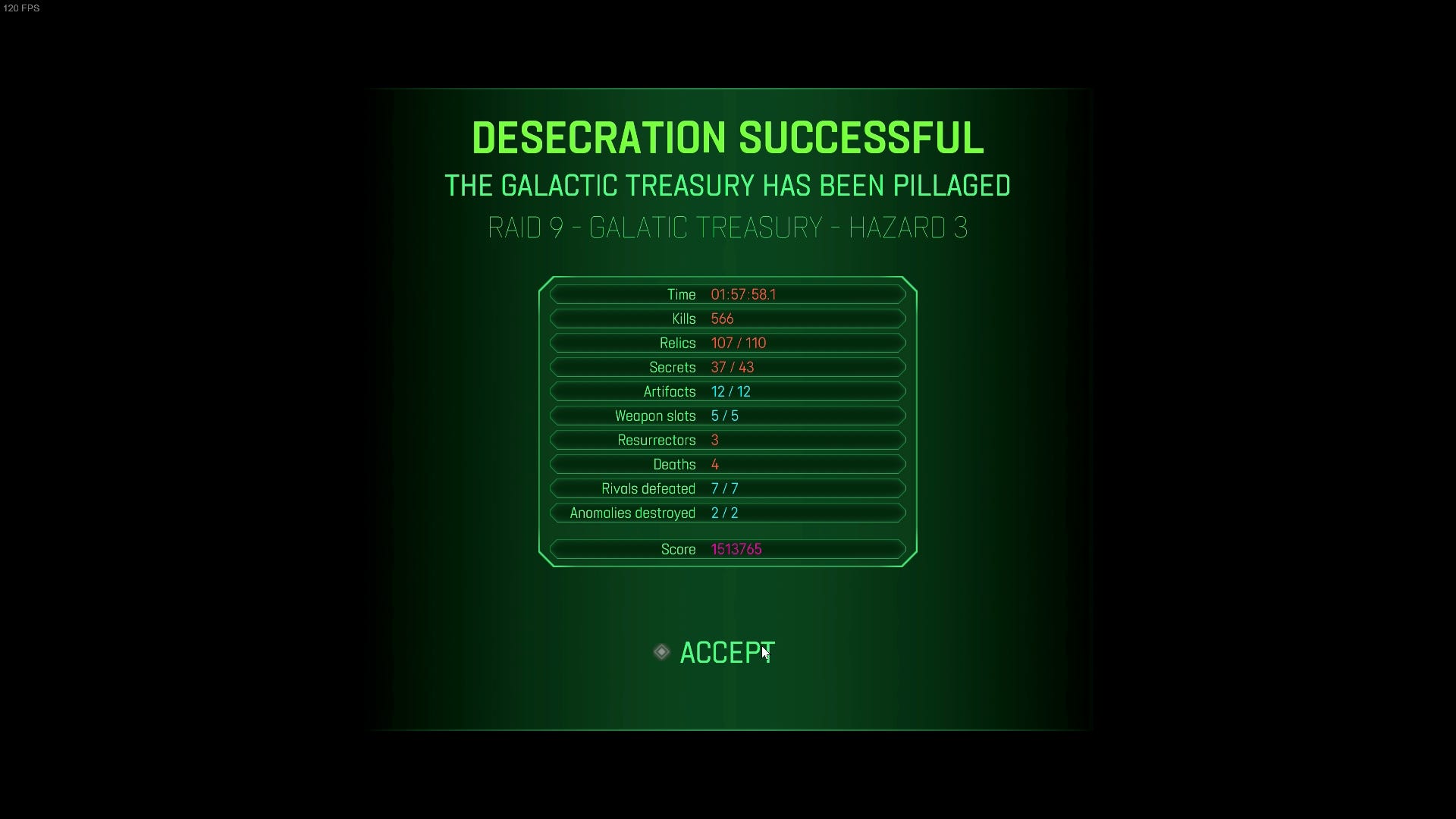
In the FPS boom of the 90s, one variant of the genre that emerged and then all but vanished just as quickly was defined almost entirely by a single series - Descent. It was the prime example of 6DoF, [six-degrees-of-freedom] a mouthful of a descriptor, a back-of-the-box bullet point elevated into a subgenre. 6DoF games exist in a curious state right between the standard FPS and a flight/space ‘sim,’ with weightless 3D spaces that can be navigated freely without regard to orientation or speed. Not only are you unbound by gravity, you can strafe, rotate, twist, ascend, descend, and move forwards and backwards at will. Sometimes all at once, to the great horror of weaklings susceptible to motion sickness. The original Descent games take place entirely in interiors, mazes of corridors, caverns, and rooms where free-floating enemies fire relatively slow projectiles at you from all angles. They’re very unique experiences, with the methodical exploration and frantic combat of an FPS both complicated by the addition of a third full spatial dimension, rather than the usual elevation changes.
Those games had a few imitators in the years following, but those imitations had little staying power, and the genre, though occasionally toyed with, referenced, or used as a set piece in more standard FPS titles, mostly died on the vine. The obvious exception is 2018’s Overload, a spiritual successor to Descent from some of the developers of those games, which is, by and large, just a straight up revival of Descent with a modern engine and graphics. It also happens to have a dedicated VR mode, which is awesome.
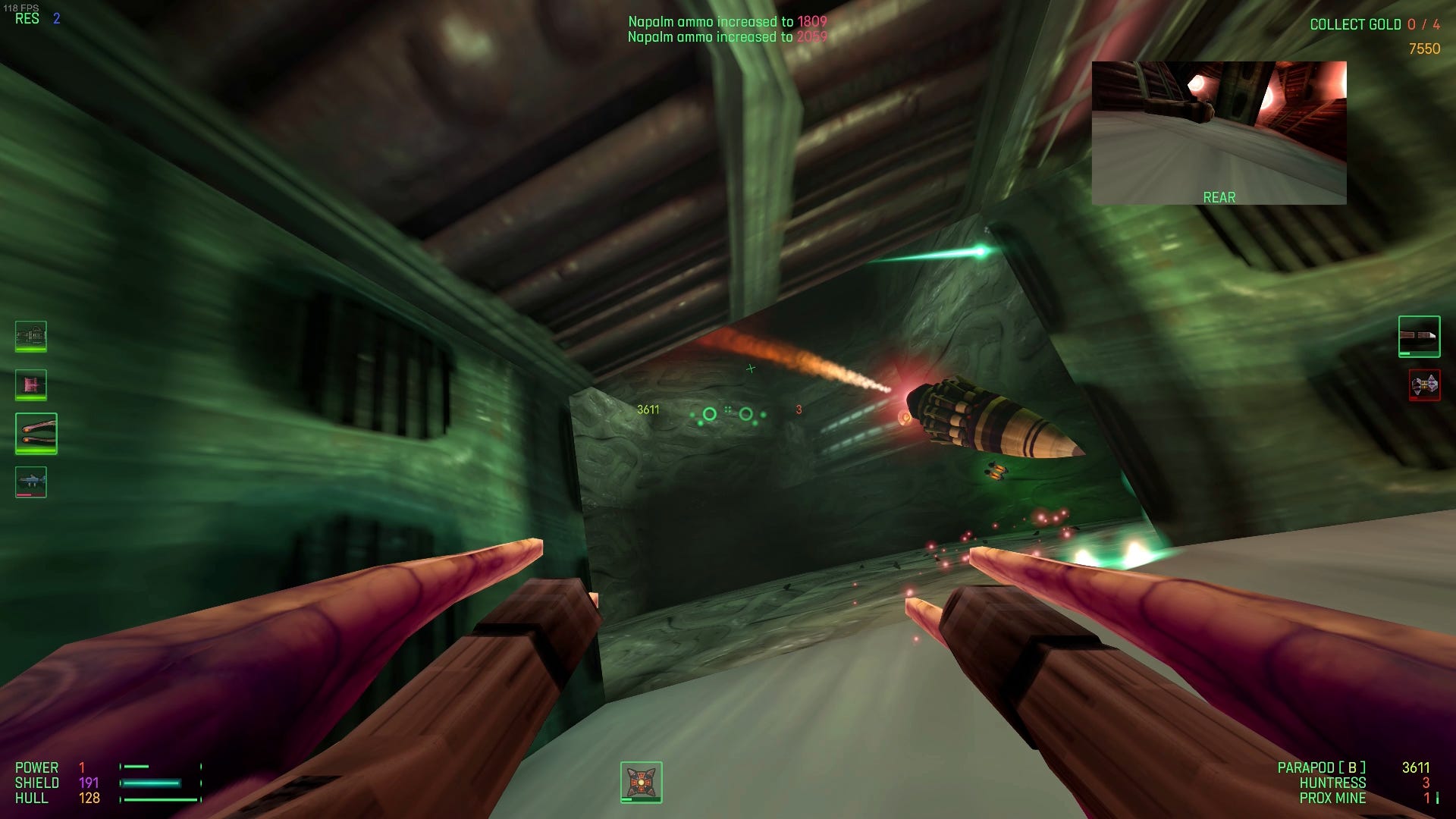
Desecrators is a rogue-lite that very much wants to emulate that lineage, and it emulates it extremely well. You pilot a little ship through twisting corridors and tunnels, blasting drones, turrets, and rival ships while weaving around like a hummingbird. The look, sound, and feel of the game is almost perfect. The enemy designs are automatons, vague in design but distinct from each other, which bear weapons similar to your own, and have their own mobility and gimmicks that make them stand out in a fight. The weapons look and sound suitably impressive, and there’s entertaining variety in your arsenal, like a missile that acts as a big, fat distributor for smaller homing munitions that it fires backwards when it hits a wall, or an energy weapon that can be charged to launch a penetrating ring of light through a line of enemies. Most notably, the destruction effects are on point. Light sources flicker when hit, and explode into shards when destroyed, forcing you to rely on your flares and headlamp to navigate the darkness. Enemies spin out of control when destroyed, firing wildly and smashing against the walls in a satisfying burst of debris. The combat in general feels weighty and significant, with some enemy types struggling to point themselves at you as your weapons knock their orientation off, and concussive blasts push them around helplessly.
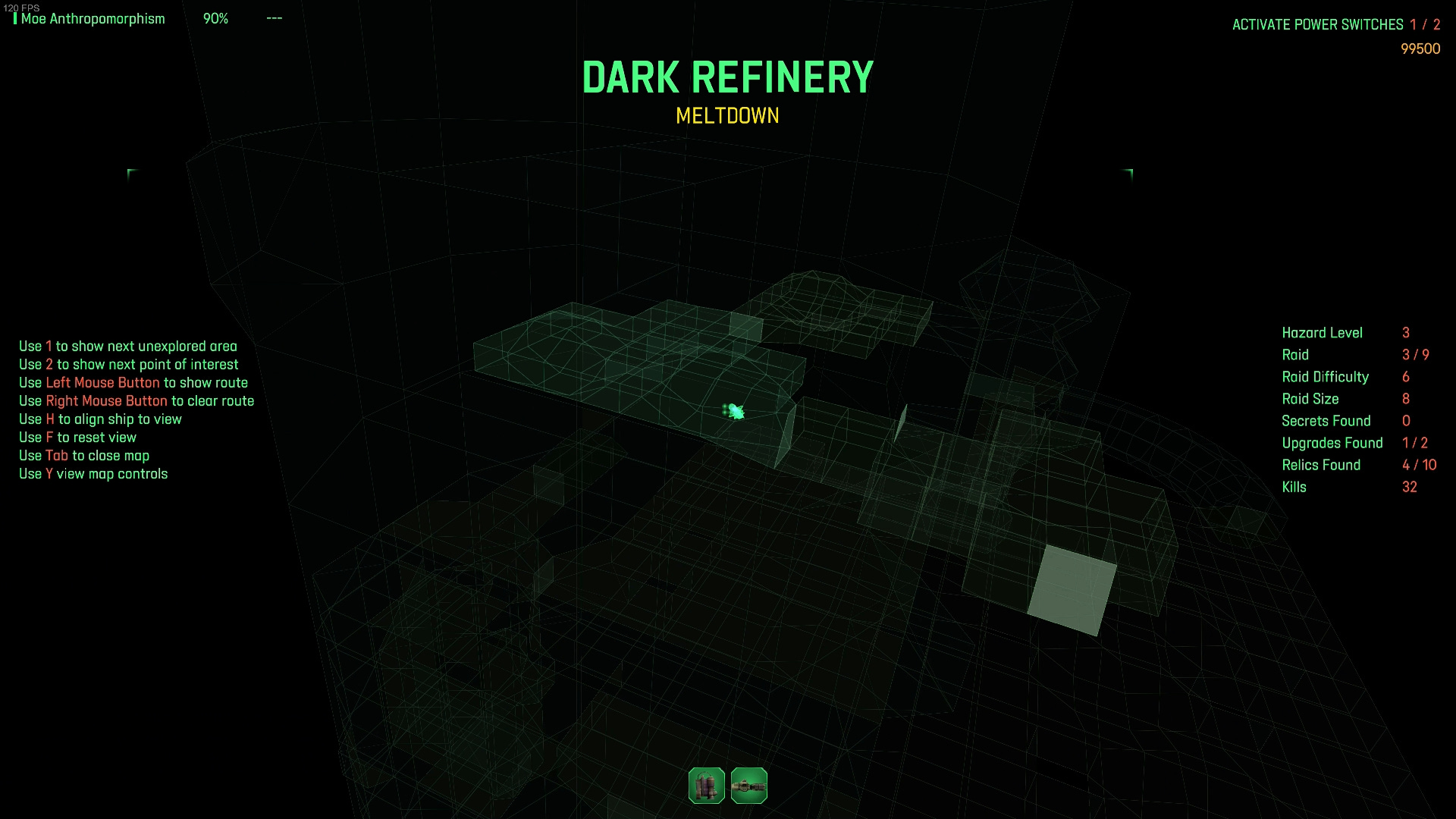
Every stage is full of secrets and destructible containers, providing ammo, powerups, upgrade tokens, and artifacts. At the end of a level, your kills, secret count, and artifact collection rate all contribute to your payout, which you can then use at a shop to pick from an expanding selection of perks and to upgrade your primary weapons. Every weapon has a single upgrade, and not only do most of them gain some DPS, but they also usually get a new mechanic that augments their usefulness. One weapon that fires an arc of energy gains the ability to bounce off surfaces and re-target to nearby enemies, giving you another source of indirect damage. The flamethrower becomes a plasma thrower, letting you use it underwater on top of having more efficient ammo consumption and range. There are a lot of other cute features, too. You get a rear-view camera feed in the corner of your screen, and another one for certain missiles or mines, letting you peek around a corner with an explosive or enjoy an FPV of you smashing into a little ship. The map is fully navigable with the same controls you use to fly, and not only can you tag any known doorway to give yourself a glowing light trail to follow on your way back, but you can even ask the game to mark the next ‘room entrance’ you’ve not yet explored, meaning you spend a lot less time flying in circles unsure of where to go. On some stages, you’ll get a sudden warning that the stage is being invaded by ‘Rivals,’ enemy ships with the same movement, weapons, and powers as your own, and extremely difficult enemies to pin down and destroy.
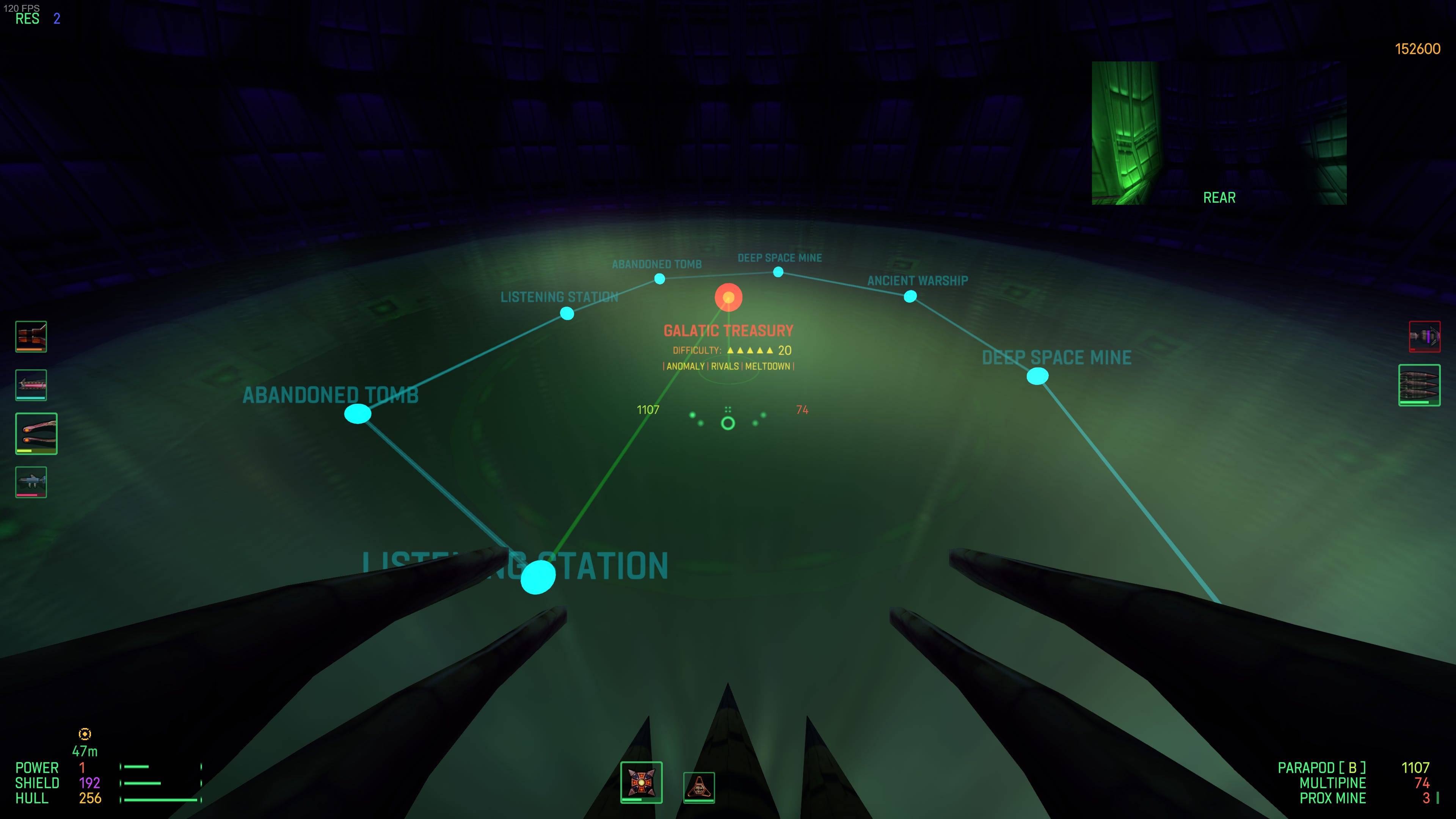
The main problem with the game is simply that it is a rogue-lite. Every level is randomly generated from a list of pre-made chunks, strung together in no coherent structure, sometimes even segmented by teleports like an old Zelda dungeon. Secrets, enemy spawns, even objectives are sprinkled through in completely arbitrary locations, and quite frequently you’ll fly into a mostly empty room and cruise around for a full minute before realizing it’s a dead end, a useless and pointless annex. Other times you’ll find a secret, within a secret, within a secret, right next to your entrance. Every time you return to your hub, you have a choice of two options for which level to challenge next. Unfortunately, there’s little room for decision making here - the names seem to only relay what tile set the level will be built with, the tags only tell you what objective type you’ll need to complete to leave and whether there’s a boss or miniboss around, and despite them displaying different numerical ‘difficulty’ levels, the actual difficulty seems to just increase linearly as you advance through a run, and any distinction between the offerings is minute or obscure. I would have preferred a lot more information - the way Path of Achra tells you outright what equipment and enemy types will be encountered on each branch. For example, I’d like some incentive to pick an objective I’d otherwise avoid, like seeing a primary weapon type I want or a perk that synergizes with my current loadout.
Once in the stages, the procedurally generated nature frequently hampers what is otherwise a very well-polished action game. Enemies spawn in based on invisible triggers, like when you enter certain doors, complete objectives, or uncover secret caches, and it’s not necessarily just a monster-closet trap. Often these spawns happen a few rooms away, and you and the new drones just kind of bumble into each other at some later point. Other times it’s too obvious - a line of mines blinking into existence right before your eyes; or too frustrating - a squadron of oppressive missile spammers camping your only way out of your current dead end. It’s not absolutely the worst idea in a game like this, and I’ve frequently praised other games using new spawns to keep a level from becoming prematurely ‘dead space’ and guiding players to new objectives. In fact, a few of the situations wound up being engaging challenges on their own, like when I found myself pinned behind a line of mini-nuke mines in a tunnel too short to safely detonate them at range, and had to engage my afterburner and skim along the wall to just barely outrun their tracking. But the bigger problem is that it’s too random and arbitrary to feel focused or consistently engaging, and that’s something rogue-likes have to be incredibly creative to address. Desecrators frankly hasn’t put that work in.
The game has five difficulty levels, each adjusting the spread of enemy health, damage, mobility, and aggression as well as a few other mechanics changes. I only finished a run on the default medium difficulty - I don’t really see the point in jacking up the stats on the enemies and having to fight more Rivals, especially when there’s no incentive beyond the extra challenge. Slightly more interesting is the new ‘gauntlet’ mode, which removes the extra lives and corpse runs the default game has in exchange for more money gain for upgrades. It’s a shame there aren’t more options or a way to customize your difficulty, like toggleable mutators for unique or challenging runs.
There’s technically a multiplayer component, though I unfortunately can’t speak on it because there’s simply not enough players. I even tried going to the game’s Discord where they apparently set up sessions but nobody responded. From what I gather, it’s just a co-op version of the regular game, with some balance adjustments, which is another disappointment - with the ‘Rival’ enemies having such a major role, even getting their own level tag to warn you when they might appear, I had hoped it was a Dark Souls invasion style thing where you could try to ruin people’s games, but I guess not.
Desecrators isn’t a bad game at all - in fact, I really liked almost everything about it. There’s a lot of really good design work that’s gone into it, but without any level design, it ends up feeling like a rough alpha or proof of concept rather than a finished game. I think a lot of smaller developers get drawn in by the siren call of the rogue-lite, lulled into handing over a critical part of game design to an algorithm, tantalized by the promise of ‘infinite replayability,’ and generally wasting good effort chasing a mirage of compelling gameplay. If Desecrators had even 1995 quality static levels you played through in sequence, I’d have gone all the way through it and given it a strong recommendation and probably a replay down the road. As it is, I cleared it once, and I really don’t want to play through it with tankier enemies so I guess I’m done. If you’re a huge Descent fan, or even just like the style, it’s probably still worth checking out despite the structure, but I’d probably recommend Overload first.