
Deep Space Exploitation
And you thought the Xbox layoffs were bad

Tired of flipping burgers? Employment history gaps got you down? No education? No certifications? No contacts? No problem! Sign up today and start earning REAL money! We provide the ship, you just need to pilot it! Everything you mine is yours! Terms and conditions apply.
DSE begins with you signing up as a contract worker for a gig asteroid mining company, juggling high explosives, dodging careening debris, and handling high power equipment unsupervised with the goal of earning enough money to purchase your citizenship. Wouldn’t you know it, though... a few days in you get slapped with a fine and loaded with so much debt you’ll have to work twice as hard just to break even before your contract is up. So pretty much just like Uber, except not nearly as dangerous or taxing.
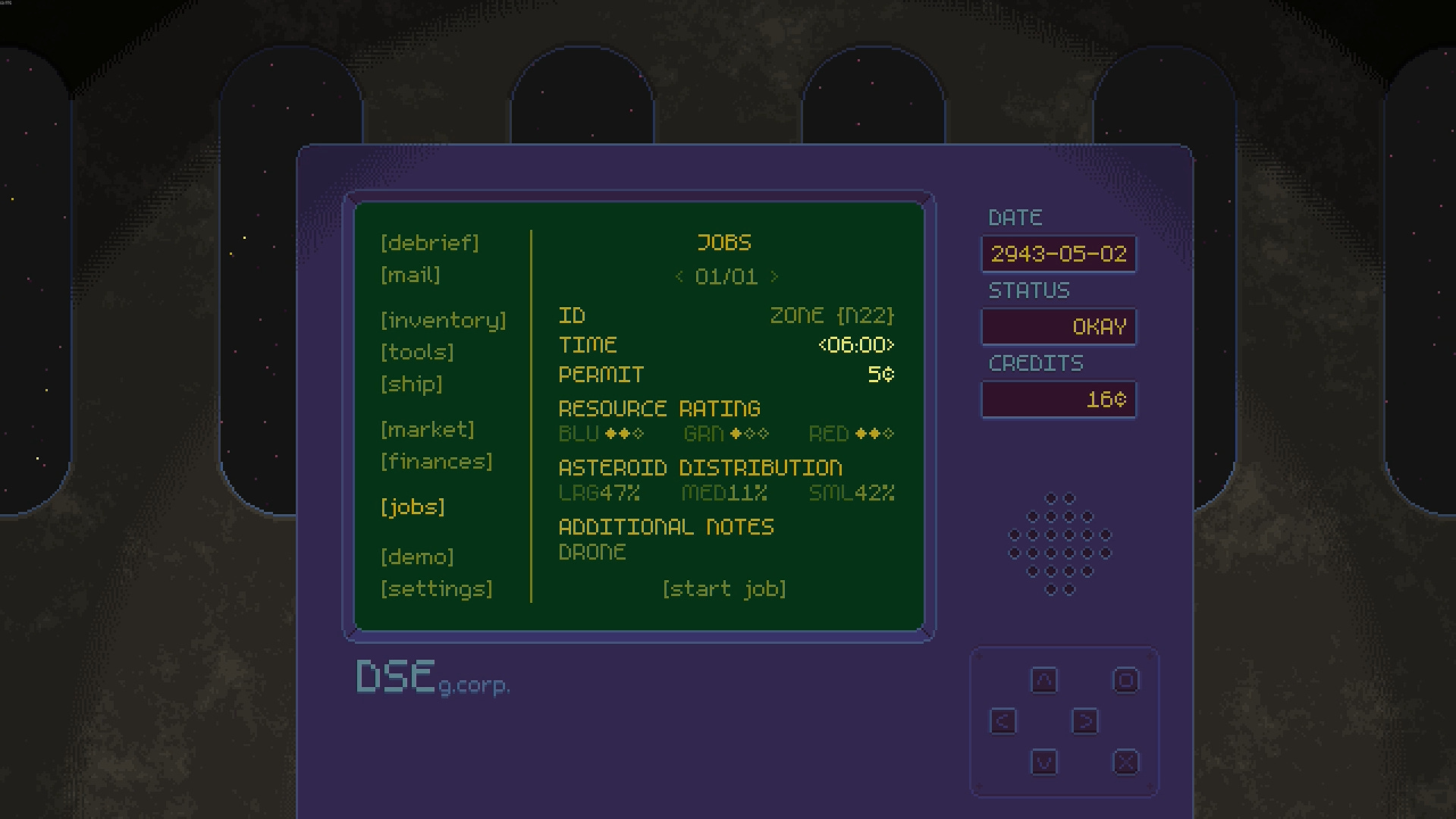
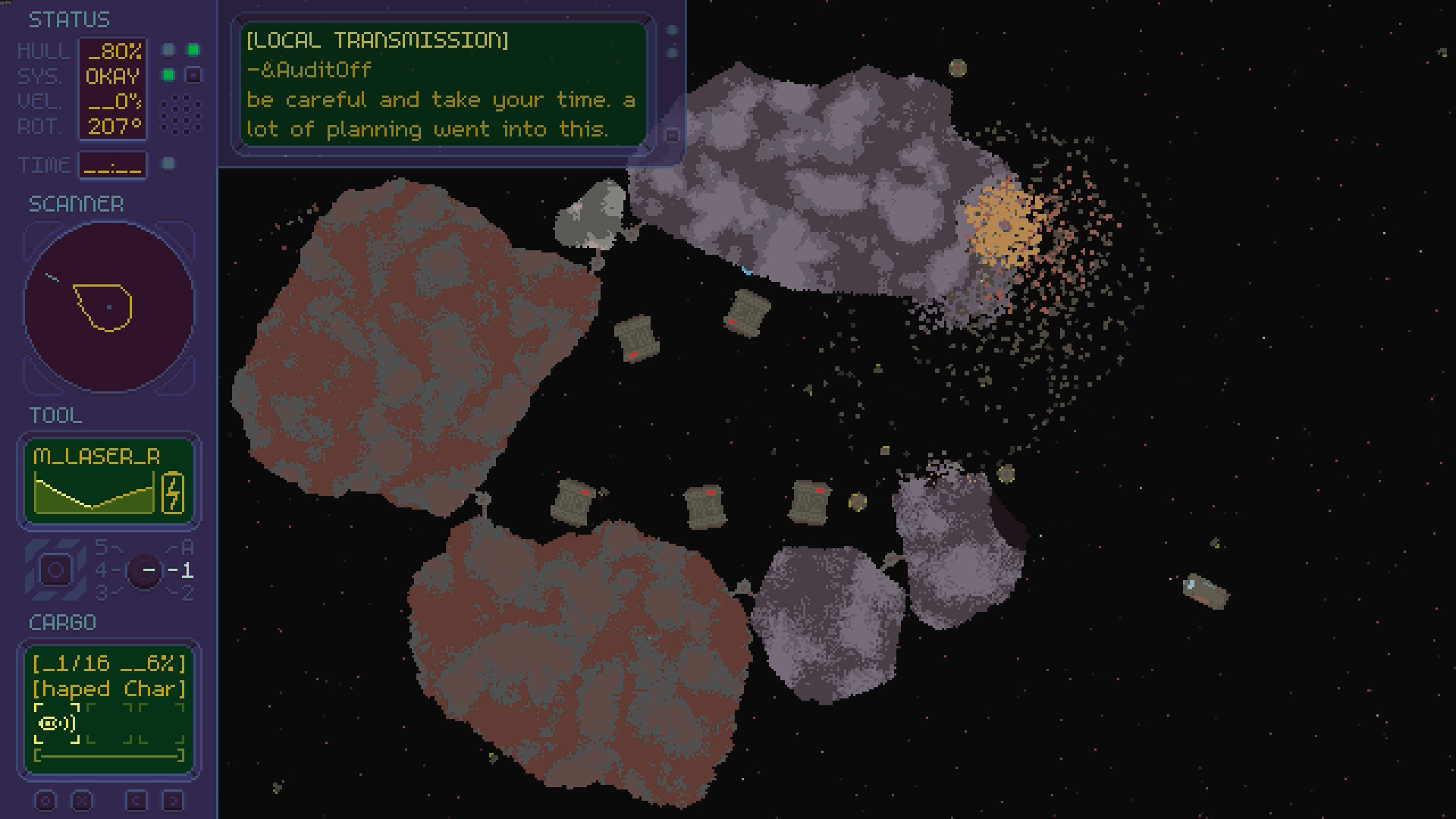
Each day, you get offered a set of 1-3 job claims, and if there’s more than one choice, you pick the one you want to work. Most jobs vary substantially in composition and profit potential, but all are contained in a single screen, with the edges looping around, bottom to top, left to right – a small, finite space where you still have plenty of freedom to shove things around, sniff for gems, and splatter yourself against a space boulder. Many job claims also come with a time limit and a buy-in price, and you can often lower the cost of claiming it by opting to shave minutes off your allotted time. You’re told right up front what sorts of gems will be present, the average size of the rocks they’ll be tucked away in, and any other important notes as the complexity ramps up.
And the game does ramp up pretty significantly. The early jobs where you spend ten minutes whittling out a full cargo bay of relatively cheap blue gems eventually give way to mad dashes to disable mines, expose and catch a few volatile red crystals, blow gashes into planetoids, and then reach your ride home before the timer counts down and you cop a late fine from your driver. There’s an expanding set of tools purchasable between missions, including some passive, permanent upgrades, explosive charges for controlled demolition, and an array of ways to punch holes in rocks. Your default tool, the mining gun, fires a small explosive round that chews through asteroids, but requires aiming and a bit of safe distance, can send smaller chunks reeling through space, and most importantly, costs money to keep topped off on ammo. There are other gun types, but also a pneumatic hammer that is cheap to operate and sends you spinning backwards on an awkward hit, a ram that lets you weaponize your speed, and finally a recharging laser that cooks a thin line of material away, giving you surgical precision at the very real cost of time.
What makes it all come together is that pretty much all of the equipment remains relevant throughout the game, with compelling benefits and equally important drawbacks baked into each tool. The laser, for example, is the obvious endgame mainstay, removing the headache of mentally adding up ammo costs as you prize out the loot, and without the need for speed or application of Newton’s Third Law. But the laser takes time to charge, can only clear a small amount of material at a time, and most importantly, can be reflected back onto your own ship or resonate with crystals to cause a feedback loop that causes serious internal damage. Especially deep in the endgame, I favor pairing it with another mining implement, which can perform the final cutting away without risk. There are even tricks you can learn with more ‘basic’ tools, like being able to hammer away a seeker mine at the last second to attempt some improvised demolition. Another important tool is the spectroscan, which lets you project a small cone of x-ray vision through rocks to see the exact spot and orientation of the resource your passive scanner is pointing your towards – sure, you don’t need it, but it’ll speed things up and save you ammo in the long run.
The passive upgrades are important too, from cargo bay expansions to let you bring home a bigger haul, to stronger tractor beams that keep a red crystal from flying off and exploding into chunks, and even including new mechanics like the ability to strafe with RCS, or turn off your automatic inertia dampening system to top out your max speed but make the controls more Asteroids-accurate permanent momentum. You can’t go crazy with the upgrades if you want to pay off your debts, but a few of them are almost essential to making the most of the later missions.
I really, really liked the core gameplay, and in most games, that’d be enough, or what story there was would be tacked on, inoffensive at best if not completely groan-inducing. But DSE genuinely does an incredible job with its narrative, telling a very blatantly anti-corporate story without a lot of overexplaining or preachiness, weaving it into the gameplay in a way that outlines its message while also giving you some genuine tension and stakes that don’t feel artificial. But one thing that really sets it apart from similar themes in games like Lacuna and Hardspace: Shipbreaker is that, despite the title making it clear what the developer’s stance is, it has the intellectual courage to present something that’s obviously bad and not sit you down for a lecture about why it’s bad.
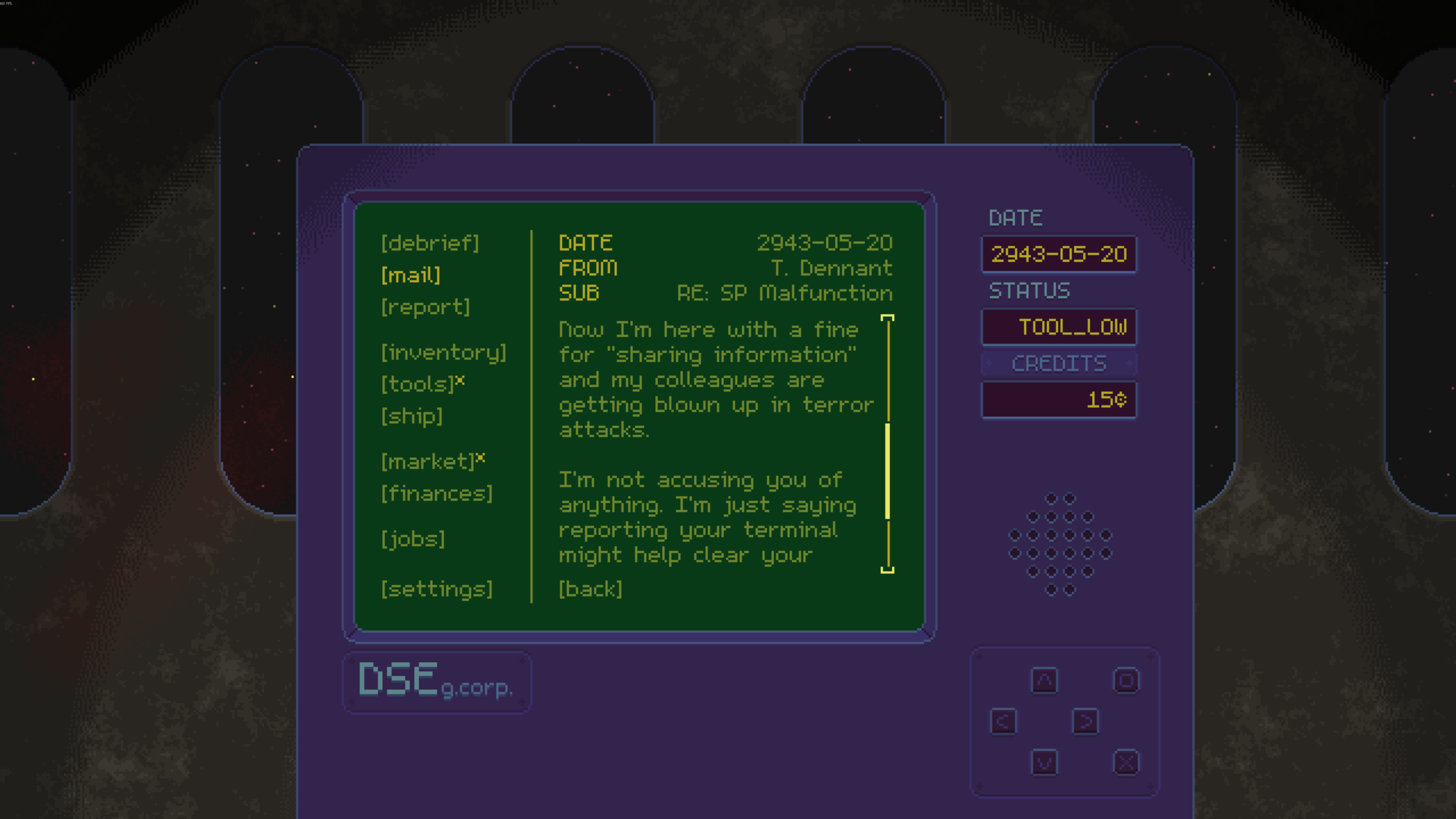
And the story, such as it is, is plenty effective, though told entirely through emails, gameplay, and ending slides. Eventually, you’ll be contacted by people fighting the company from within, and have the option to assist them, at a cost to yourself, incurring further fines for negligence and damaging company property. But the game even presents siding with the ‘resistance’ with some nuance, making it clear that other people are suffering and dying in the crossfire, including some just as desperate as you. Maybe most impressively, you can ignore the ‘good fight’ entirely, keep your head down, and legitimately earn enough of a nest egg to escape under your own power if you play well enough, which is a concession I wouldn’t necessarily expect from what is otherwise a pretty rabidly anti-corporate screed.1
Even beyond the political overtones, DSE has a surprising amount of nuance in a tight little package. Scrap refining missions start cropping up as a sort of slow-paced low-buy-in option, and if you take those up enough, the engineers running the program pull some strings to get you on the white list for cheaper repairs as thanks for helping them out. Later job listings include some posted by the militarized subsidiary that buys out your debt in the bad endings [resulting in you being sent to the frontlines of ‘peacekeeping’ operations as cannon fodder] whose fields are more and more thoroughly mined – and I don’t mean depleted. Clearing mines without killing yourself or damaging company property is one of the few things that earns you a steady bonus, and assisting them in making these lucrative sectors safe from econo-terrorists means they eventually entrust you with military-grade codes that let you remotely disable mines and hack open storage containers to requisition the booty inside without detection.2
There are quite a few endings, depending on whether you pay off your debt, whether you perform sabotage at the bidding of a hacker, and who you report to the company, and the one potential drawback is that the game autosaves, meaning you arrive at the final day pretty much locked into whichever ending you’ve earned for that run, and need to start all over to reach another. Except it’s not actually a big negative in my opinion – the game is short enough, has enough variety, and rewards masterful play in ways that make any excuse to go back through worthwhile. I found myself appreciating a lot of smaller details [like the final scrapping mission where you’re cleaning up a graveyard of sabotaged dropships] that I’d missed on my first or second playthrough, and the game even lets you skip the basic tutorials and start a few days in when you begin a new run. I also found it really cool that the jobs themselves are not, as you might expect from this kind of game, procedurally generated, but all hand-crafted, so though you will eventually, through many runs, start to recognize specific layouts and features, you still have enough variety of equipment and ways to tackle a challenge to keep it fun and fresh on repeat plays.
I can’t recommend Deep Space Exploitation enough. It’s a lot more accessible than something like ΔV: Rings of Saturn but just as compelling in its own way, and the time and debt pressures turn what could have been a dull grind into a consistently engaging finite span. It’s confident in its decisions, it’s well balanced enough to be challenging without being frustrating, and its core gameplay is genuinely fun on its own. It’s even got a little minigame you can access in your equipment screen. How cute is that?
Deep Space Exploitation can be purchased on Steam or itch.io.
Apparently there are even endings where the resistance rescues you from your conscription or assassinates you for being a company dog, but I didn’t end up getting either of those
One funny detail I just remembered is that you can buy ‘refurbished’ explosive charges at a discounted price, and they have timers that are too short for you to arm them without getting caught in the blast radius and incurring more repair bills than the price offset is worth. Hilarious.