
BALL x PIT
Imagine four balls on the edge of a pit.

In the annals of history, there are records of moments when human discernment failed, and a population was seized by an irresistible and bewildering passion for consuming worthless nonsense. The Dutch Tulip Mania, Pet Rocks, Beanie Babies, kale, and now, the most recent example, Vampire Survivors clones. When an innocent little idle shooter became an overnight viral success, it spawned an entire industry of desperate indie developers, all certain that their iteration will be the one to recapture lightning in a bottle. Maybe what everyone who moved on from Vampire Survivors needs is a different art style, or maybe the inclusion of deck-building, base development, and romanceable NPCs. Maybe it should be accelerated, slowed down, made in 3D, or grafted to another genre entirely, so as to create the perfect hybrid, like a pluot or a grape that tastes like birthday cake or some other crap they sell for inflated prices in the produce aisle.

BALL x PIT is Vampire Survivors crossed with Breakout.
Your characters slide around a constantly scrolling vertical field, with enemies spawning in at the top and sliding down, attacking you if they reach the bottom alive, or if you directly bump into them. Meanwhile, your character fires out balls, with the angle set by your mouse or second stick, bouncing off the sides of the field, the top of the screen, and the typically squarish foundations of the enemies, which damages them a little, before either hitting the bottom of the screen and getting collected automatically, or being caught by your character directly. Those balls take the role of weapons in most Survivors-likes, each one having a set of attributes and damage values which determine their effectiveness, and each can naturally be upgraded and then combined with each other to create even more powerful balls.
And, to be honest, it works pretty well. The effect is that, like in any good Survivors-like, you’re forced to give just enough moment-to-moment attention to maneuvering, positioning, focus firing and sweeping up rewards, expend just enough thought on item choices and upgrades that augment your developing build, feel just enough sparks of dopamine in getting a shiny reward roulette or lump of meta-currency, without ever truly forcing you to engage. Your eyes, your hands, your dim, task-oriented awareness are all occupied, leaving your mind free to engage with, or pretend to engage with, whatever else is going on. Sitting on a plane and trying to burn a couple hours without really thinking about why you’re on a plane? Play some BALL x PIT. Waiting for a plumber to arrive, and losing faith that his promised schedule window is going to be met? You got time for BALL x PIT. Taking a phone call from a barely tolerated relative? Turn off the volume – you don’t need it for a round of BALL x PIT, baby! I refer to these as podcast games, and I think that gets to the heart of their essence, their design, their ethos, and their criteria for success better than any reference to mechanics, viewpoint, controls, or inspiration. They’re games you play while doing something you would rather not devote full attention towards.
As you play, you unlock a lot of things – new ball types, new passive items to choose at level up, new characters, and new building blueprints. The character variety is surprising – not only does each character have their own starting ball type, they also usually have some kind of overarching gimmick. The Juggler lobs his balls into the air rather than sliding them forward, letting you choose between attacking the front of the horde or their backs as smoothly as you can aim. Many characters are even more unique – one is actually a pair, who stand side by side and split their damage between their mirrored shots, while another plays the game in an amazingly well-realized turn-based mode, with everything sliding forward a few notches before allowing you to take your time lining up a single barrage.
Each character you unlock requires a home to be built, and that leads elegantly into talking about the base management. Between rounds, you return to a small square plot at the top of the pit, and can plop down buildings and resource patches, purchase expansion plots, and finally, send your unlocked characters out on a foraging mission, fired off at your chosen angle to bounce around, reaping wheat, chopping trees, and building or upgrading structures one bump at a time. This is the main way you’ll earn the resources required for putting up more buildings as you unlock them, and the buildings are how the game handles meta-progression [besides permanent level ups for individual characters] and adding mechanics. Not only do you need to slap down a blueprint and send people out to bump together a house for each new character, you also have buildings for improving your initial stats and your overall stat scaling, giving you a free ball or passive at the start of each run, passively generating resources while you play, and more.
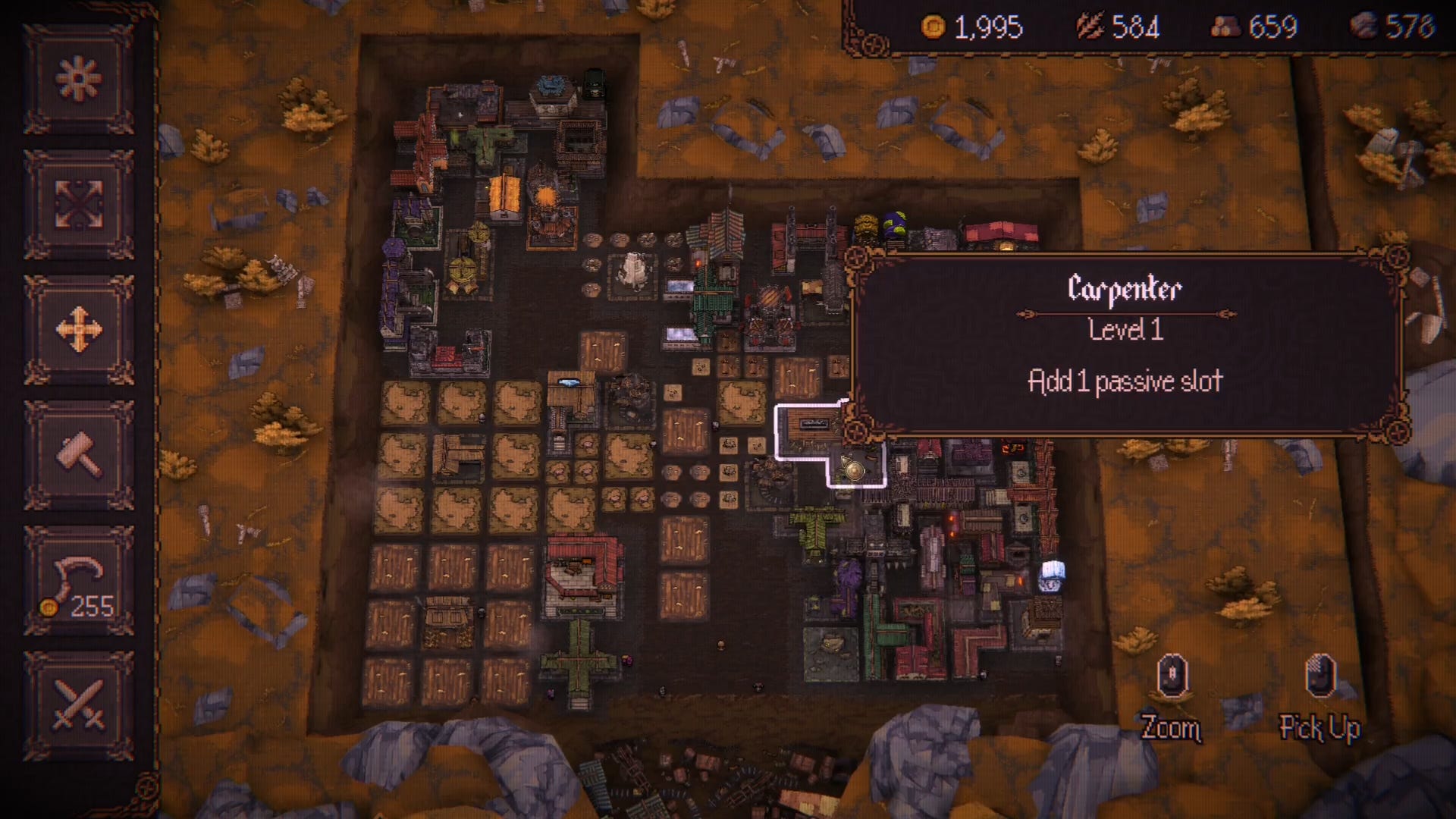
Some of the buildings offer enormous benefits, some can be upgraded multiple times, and each one takes up some amount of space in your plot, forcing you to shuffle things around, do a little bit of grid packing, and then cash in, basking in the satisfaction of watching your little pinball machine light up and flash increasing numbers in your face. As with almost everything it does, Ball x Pit does an exemplary balancing act with the base building, making it require just enough attention to not block off wheat fields and unfinished buildings, but not making you feel too bad if you don’t bother to optimize an ideal layout for maximal production.
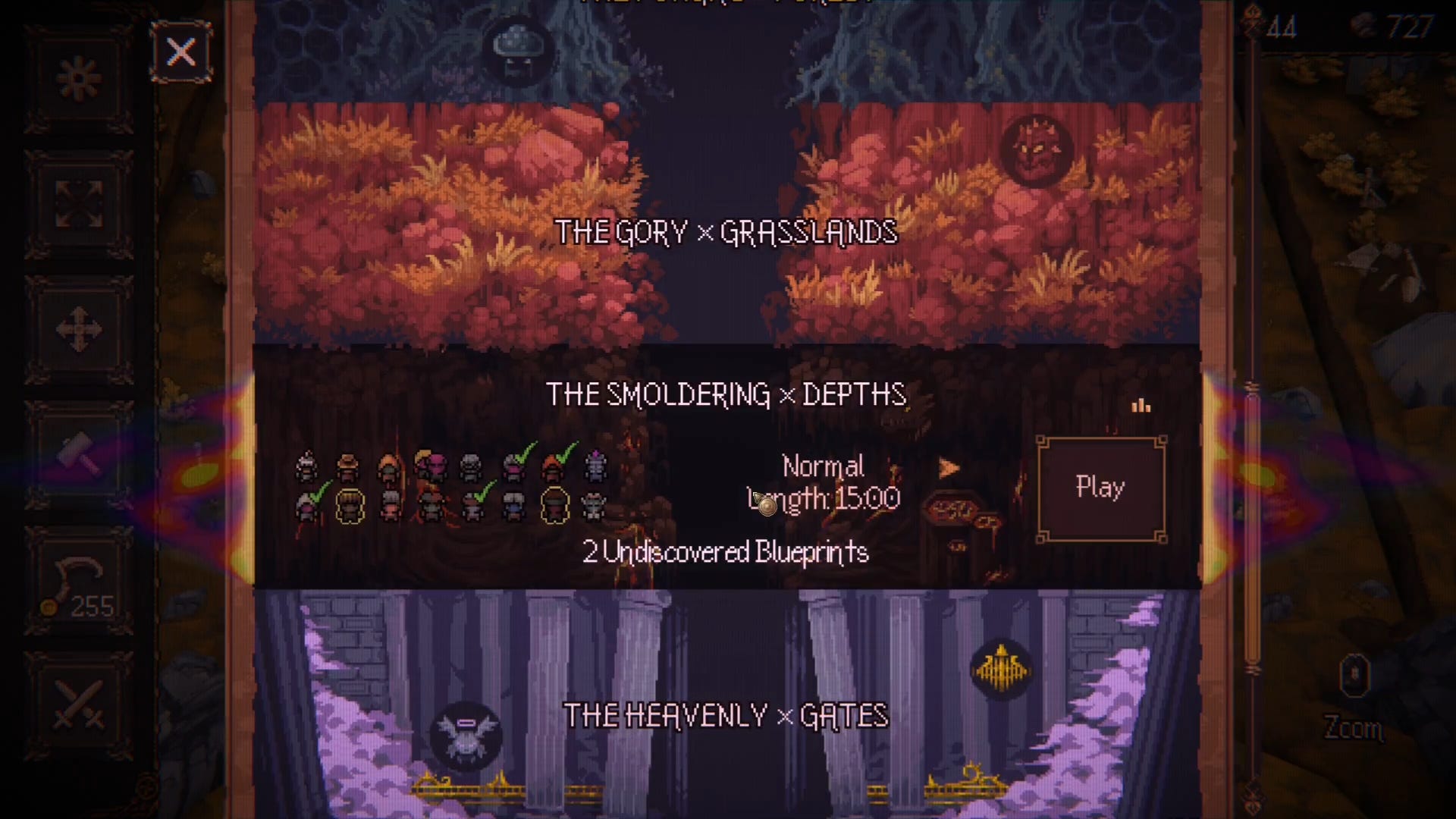
Of course, your main goal is to unlock progressively difficult stages, which you do by finishing the most recently unlocked one with a minimum number of different characters. Once again, Ball x Pit manages to wring just about all the creative potential out of its format that you could hope for – enemies start to become more than just tiles that threaten to inch past you before getting bumped enough, with some firing projectiles for you to dodge, accelerating nearby tiles, or even catching and holding one of your balls captive until you can focus them down and free it. And the game also encourages you to revisit earlier stages frequently, as a way to easily level up newly unlocked characters while also augmenting the totems that increase your power for each discrete character that has finished a given stage.
Finally, you can ramp up the difficulty by cranking up the speed – actually, there are two different ways to do this, one by adjusting the overall playing speed within a round, which is really more of an accessibility setting to give people with slower reflexes less trouble avoiding hazards, and another by way of the Fast and Fast+ options when starting a stage. The Fast modes trim the run down by a few minutes, but keep the number of enemies roughly the same, resulting in much more dense and fast-moving waves to keep at bay. It’s especially nice that you can take a character in at Fast right off the bat, which keeps the aforementioned revisits somewhat challenging even when you’re nearing the end of the game’s progression lines. And it helps that the game sessions are quite short, even by Survivors-like standards – 12 minutes [minus menuing] feels a lot better to me than the standard 30 or even 20, which is often considered ‘accelerated.’ Keep it short, guys. I may be gaming on the toilet but I don’t need hemorrhoids.
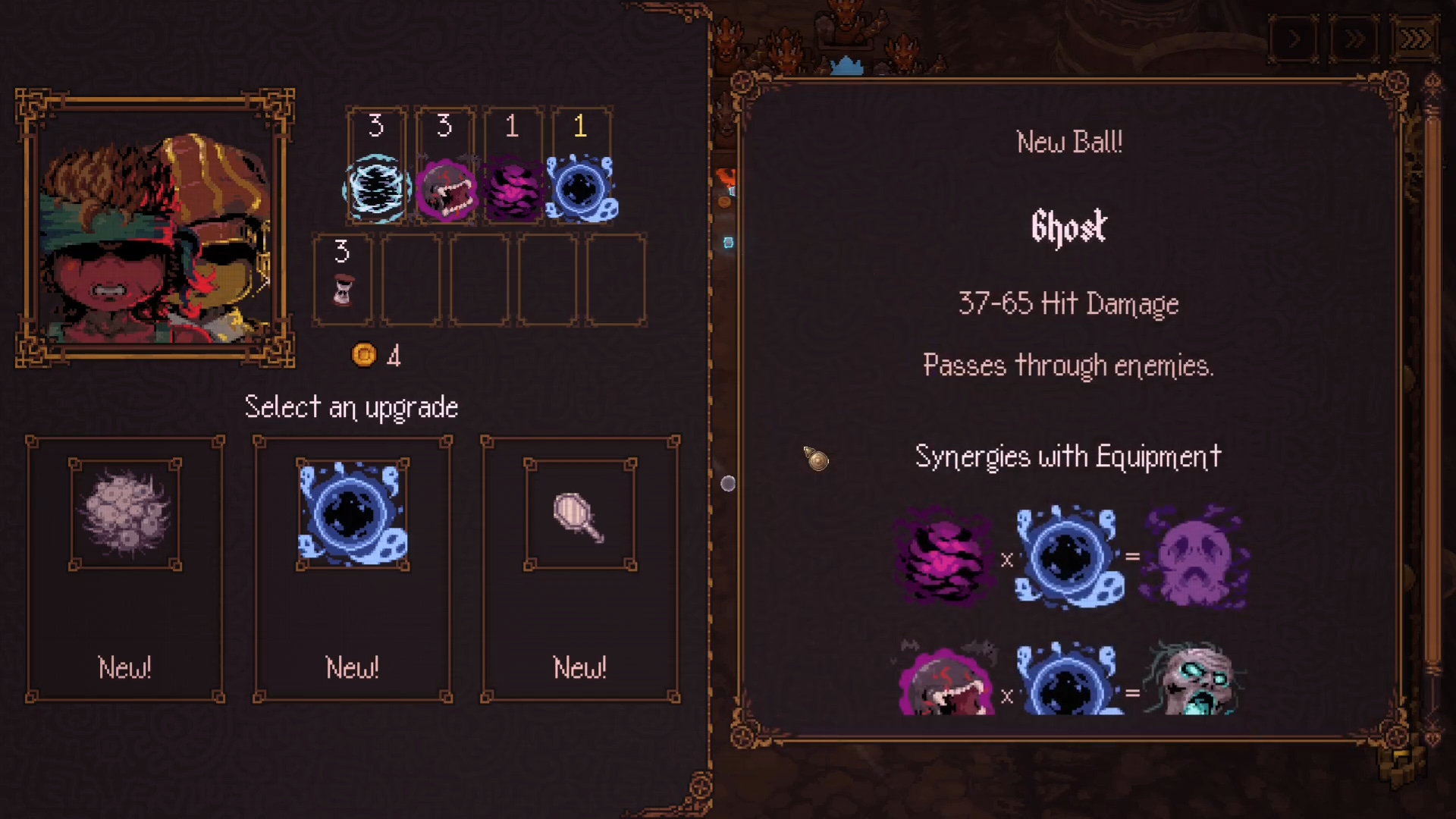
But for all the game’s merits, and to be clear, Ball x Pit is in many ways the pinnacle of podcast game design, it still ultimately suffers from the very design conceits that keep it in that ideal, dreamlike, Machine Zone state that all Survivors-likes aspire to. Because you’re not expected to fully devote your attention to playing well, if you do try to speed up your progress through conscious effort, you’re likely going to come away frustrated. The moment-to-moment action is too hectic, too bound to what is effectively random chance, and a bit like trying to do well at Peggle. Insist on attempting things at Fast+ rather than slowly building up levels and stat bonus structures, and you’ll find yourself simply lacking the DPS to accomplish much, though you will, of course, continue to crawl your steady way up the persistent progression ladder anyway. The final blow comes with the last character and last few building blueprints, which do the unthinkable – utterly remove your need to ‘play’ the game at all.
Some of the earlier buildings allow you to station a character in the base, automatically collecting from deposits of a certain resource type rather than joining in the harvest run. Later on you get buildings that let you send a character to ‘complete’ a stage on their own, though it’s really just a timer that makes them unavailable and provide a preset amount of booty on their return. These wouldn’t be bad on their own, but they are a necessary context for the final twist. Your last character unlock has the gimmick that he behaves on his own, and plays the chosen level himself. And what’s worse – he’s actually pretty ‘good’ at the game. BALL x PIT crosses the final, forbidden threshold, and removes human control entirely, transforming it from a podcast game into something darker, something odiously insipid, an idle game. This last character can even tag along with any other character in the game, and the two of them can tie up your computer and your screen for tens of minutes playing BALL x PIT without you, as you go get a coffee, or look at your phone, or stare glassy-eyed at the lights and colors and moving shapes on screen. And once they’re done, they’ve made real progress – loads of XP, totem bonuses, a free harvest session for you to click twice and then watch even more jangling sets of keys.
This does come near the end of the game, so it’s not as though it ruins much, but it is a denouement that leaves a bad taste in my mouth. What’s even the point of booting up BALL x PIT now, when the most efficient route to development is to let an AI play the game for me and then act as the AI’s gardener between sessions? What satisfaction could I get from improving a character, straightening up my base, or clearing stages with each character, knowing that the developers coded an algorithm that could do it for me? I’m not going to pull out my Steam Deck on a cross-country flight, boot up BALL x PIT, and then watch the game play itself for three hours. People didn’t set up Pindlebots to grind a Diablo 2 miniboss for weeks and then sit there and WATCH it happen. Even Cookie Clicker makes you click on shit! And once you get to that point, you’re forced to confront the looming dread of existential doubt – am I even having fun playing BALL x PIT when I haven’t handed the controller to a digital little brother?
Well, sure you will, for a while. It’s a podcast game that’s right up there with Holocure for being a rare attempt to not merely cash in on a simple format, but to try to expand on it, give you a reason to inhabit it, rather than just burn a couple hours with it flashing and chirping into your eyes. The fact that it then falls on its sword so spectacularly and ironically is, in a way, kind of cool. “You’re fucking done with BALL x PIT, kid” the game says to you. “We’ve got it from here. Find something else to do.” And I will.
BALL x PIT can be purchased on Steam, Playstation 5, Nintendo Switch, or on Xbox Game Pass.
Oh wow, that's definitely a game I wouldn't even consider getting nearby, if it weren't for your commentary and reviews on it. Seems very fun! The videos made me realize the game's graphics are quite charming tbh.
From what you wrote about their "final statement" (the game doesn't needs you to play it, go find something else to do), it could be taken as criticism towards AI's fast-paced evolution, and how it can make humans feel obsolete and wonder whether they're really necessary at all.
IDK how they framed this, though, so that's just a random interpretation without the full context.
The only thing that’s missing is a character to optimize your town layout for you and auto-upgrade stuff lol