
Abiotic Factor
GO TO THE BATHROOM!

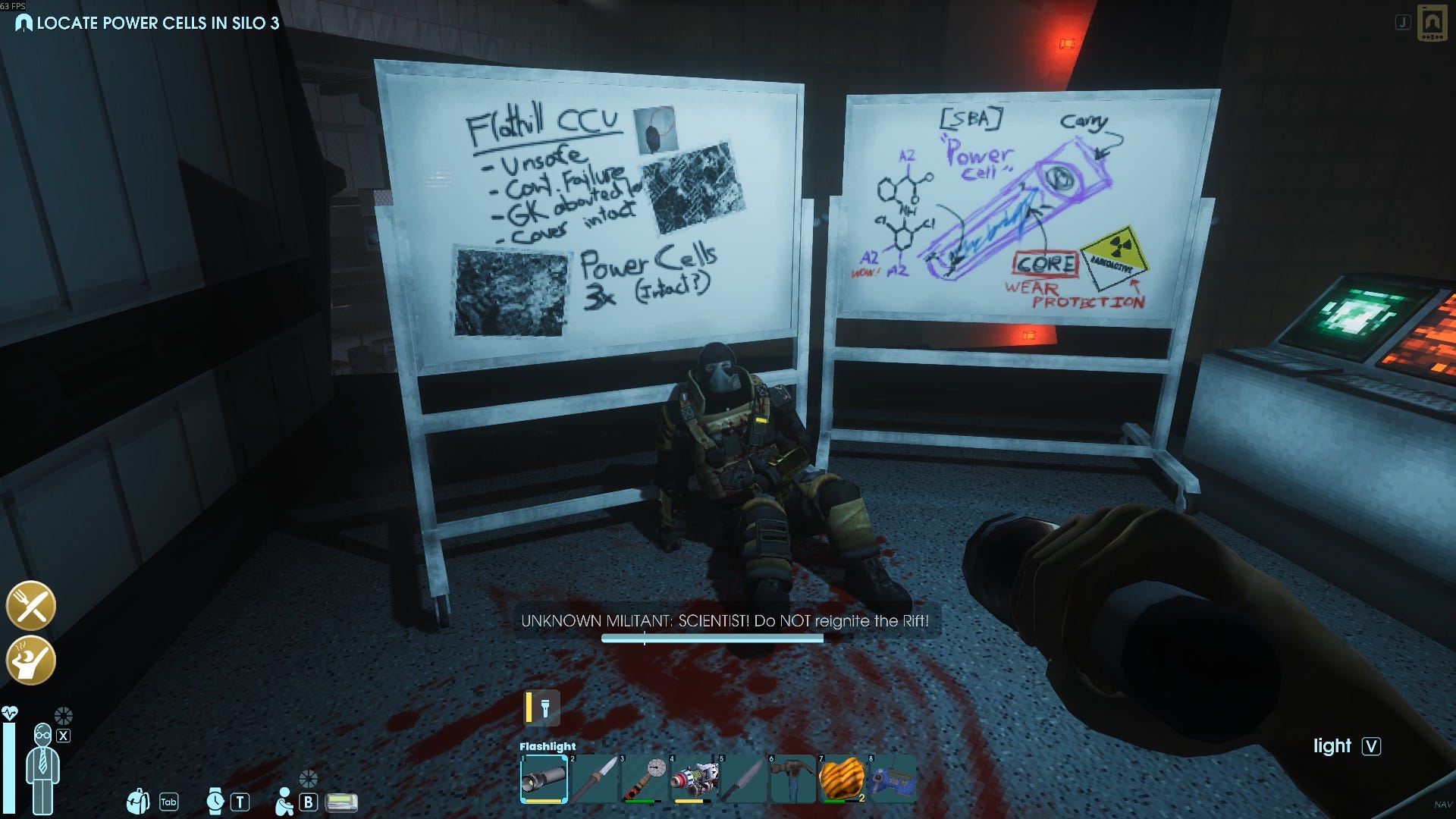
Abiotic Factor is many things to many men – it may be a survival horror game, it may be an open-world explorathon, it may be a miner and crafter, hell, it may even be friendslop… if you even have any friends, you nerd! You play as a scientist who gets dropped off at the inconspicuous entrance to a massive, secret, underground research facility for their first day of work, which never properly begins. Before your orientation is complete, the facility is plunged into chaos, invaded by alien interlopers, gas mask fetishist troopers, and little hopping pests lurking around every corner and in every ventilation duct to pounce on you. I hope this all sounds familiar, because as you may be able to tell, Abiotic Factor, at least initially, rides hard on nostalgia for one game in particular.
Once through the tutorial and a brief loop around the cafeteria, you gain access to the Offices sector and the game proper begins. Most of the locations in Abiotic Factor are large, fairly open sprawls, with multiple floors, loops, and locked doors and elevators for you to unlock as shortcuts. Each zone also has a few major objectives, mostly directing you to the next zone, and typically require you to find some kind of new resource, material, or blueprint required to craft the key to further progress. Along the way, you’ll also learn recipes for all kinds of optional gear, new weapons, armor sets, and tools that assist you more indirectly. It’s a little bit like the progression loop in Terraria, and I mean that in the nicest way possible.
Eventually, your need to visit a crafting table to assemble most of your new toys, and the need to stockpile large quantities of varied odds and ends to craft with, means you’ll probably settle down in one peaceful[ish] corner of the early game, stacking crates on each other, plopping down new pieces of furniture and specialty crafting benches, rigging the whole thing up with power, then backup batteries, and eventually a whole tangled mess of cables, just like you have under your desk in real life. There are a lot of purely decorative items, and there are occasional enemy spawns that will attempt to batter your base of operations, but I wouldn’t say that the building and defense of a base is a huge focus of the game. You can do a lot to mitigate any real risk of enemies doing damage to anything important to you, it has little mechanical importance besides being a hub for crafting and storage, and the only firm requirement is a power outlet somewhere nearby.
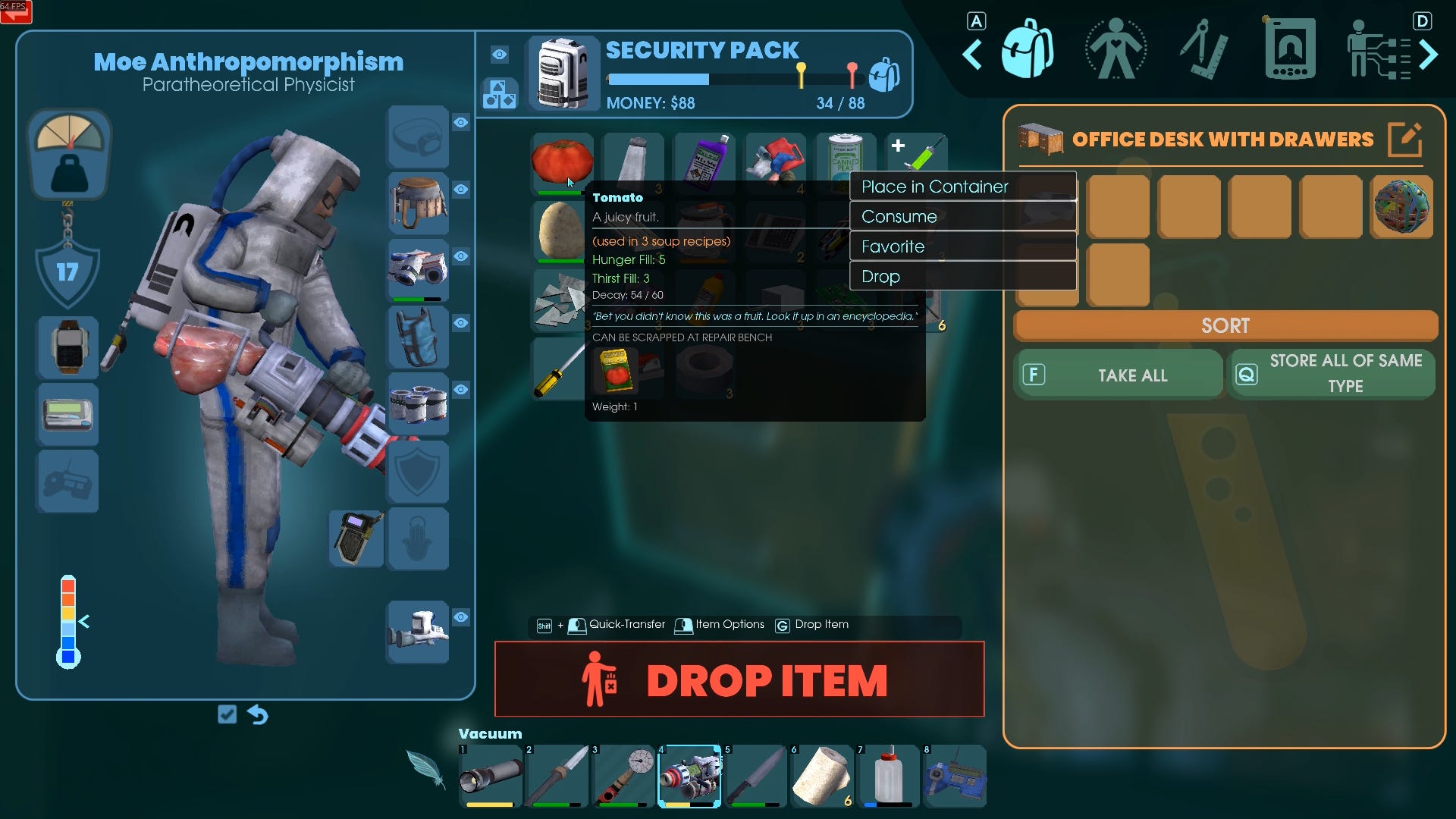
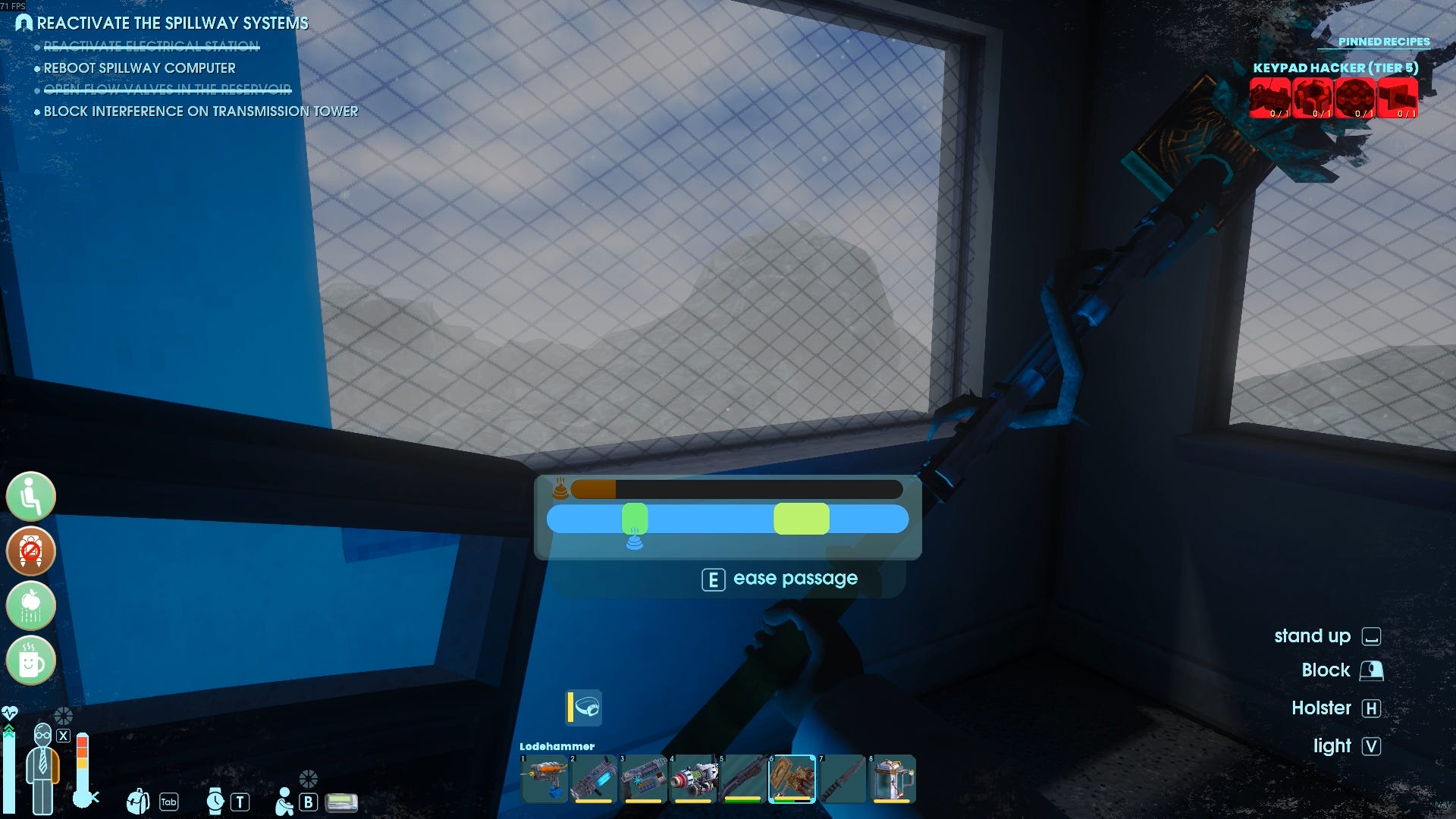
The survival elements are similarly somewhat superficial. There are meters for hunger, thirst, fatigue, uh… intestinal urgency… and each of these needs to be kept filled, lest you get assaulted with a giant ticking doomsday clock telling you of your imminent death from starvation or dehydration. Or you shit yourself. Shitting yourself, or becoming filthy in other ways [like chopping up corpses for resources] can eventually lead to you gaining a sickness debuff, but for the most part it’s just included for the fun of it. It is recognized that the developers of Abiotic Factor have a funny sense of ‘fun.’
Of the survival mechanics, by far the most involved and least pointless is actually the hunger meter, as the game features a multitude of different sorts of edibles, raw bits of interdimensional aliens to grill, and dozens of recipes for gumbo. You can set up farming plots, carry whole refrigerators home, stock up on tomatoes, potatoes, canned peas, and even go fishing in the many pools of stagnant water throughout the facility [and multiverse] all to simmer up a couple jugs worth of soup. Many of the more involved foodstuffs come with some decent temporary buff, and learning the benefits of each new stew you’ve unlocked is a cute little side project as you’re winding down from a real outing, but nothing about it is gamebreaking or terribly essential.
Another major aspect of the game, or rather, another thing the game keeps forcing on you, mostly against your will, is the combat. At various stages of the game, you’ll cycle through a huge variety of weaponry, yet the essence remains fairly static. You’ll have a melee implement for sneak attacks, burst damage, and as a fallback, you’ll have some ranged weapon with crafted or otherwise limited ammunition, and you’ll have a handful of grenades or the like. Some weapons have better reach, some can be held in one hand with a shield in the other, some provide elemental damage, and very little of that matters much in the grand scheme. Headshots do extra damage, as does a hit against an unaware enemy, and those are by far the most important factors in succeeding in combat.
But you’ll have to do plenty of direct combat anyway, because the game has a ton of enemies, most of them are directly impeding your progress, quite a few respawn periodically, and you can’t always guarantee an opportunity to assassinate them cleanly. And the combat, honestly, is nothing to write home about. ‘Human’ enemies do seem to have rudimentary AI, and will throw grenades to flush you out, but most of the other entities just kind of run at you and spam attacks as you circle strafe around poking them or whatever. Even open fights with humans are more frustrating than engaging, because everything that’s actually aggro’d feels like an insane damage soak, and, in many cases, a waste of ammo.
The last big feature of the game, beyond the combat, the base building, and survival, is the exploration, and thankfully, it’s good enough to render most of my complaints moot, or even redeem the otherwise underwhelming qualities of the gameplay. The sections of the facility you gain access to are impressively massive, fairly complex, and surprisingly physically grounded. One area is a series of tunnels and caverns, connected with roadways that you can cruise along in a hotwired forklift, with huge bridges, military camps, garages, a giant containment room filled with radioactive waste, and all kinds of side passages and shortcuts back to the various parts of the Offices sector. Another takes place along and around an enormous hydroelectric dam, with the reservoir beneath giving you access to tertiary facilities and outposts.
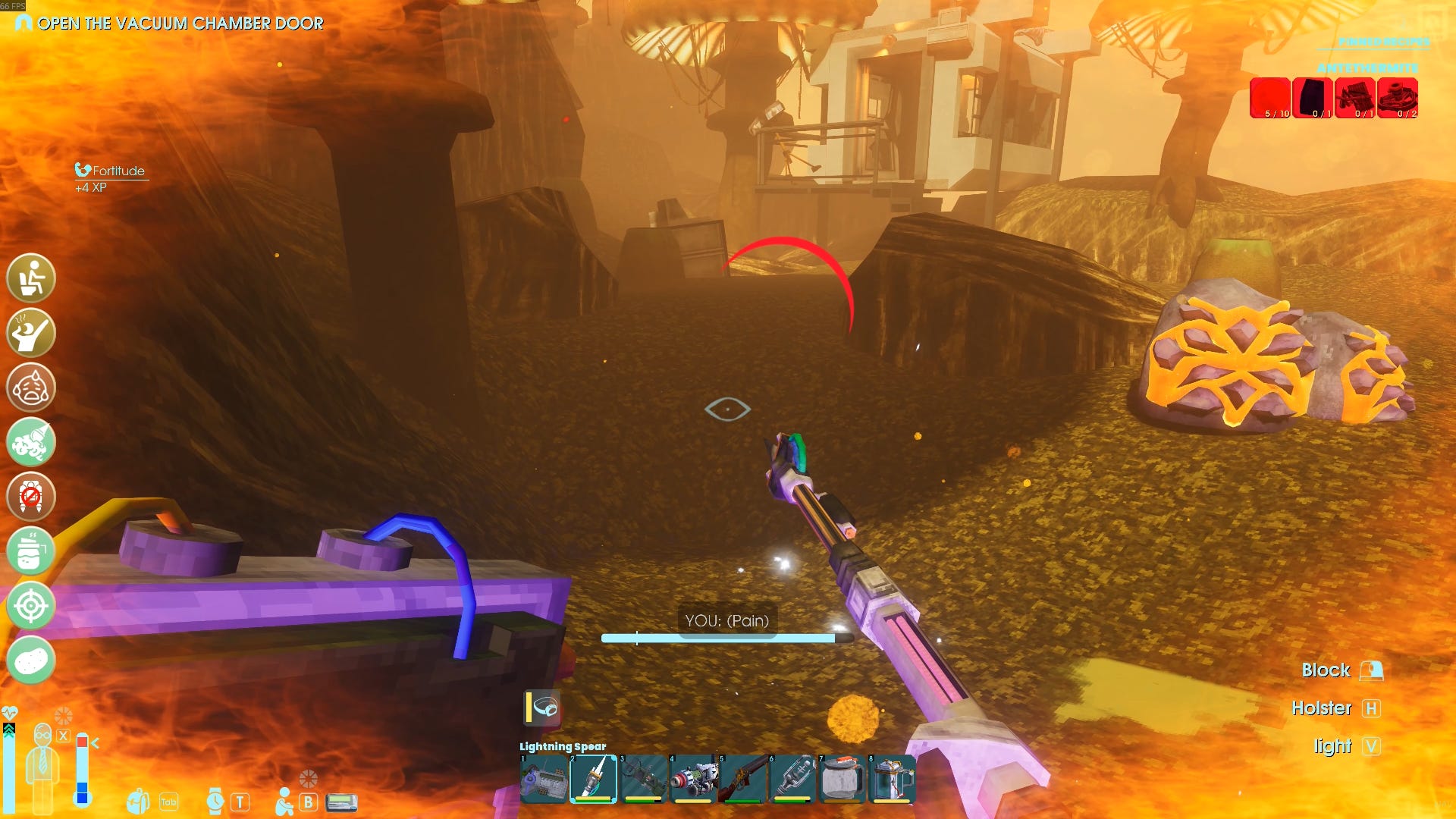
Each sector also has a handful of stable portals, some serving as shortcuts around the facility itself, but many others taking you to entirely new worlds, [mostly] smaller, self contained instances, and usually thematically isolated. The first you’ll likely visit is an obvious nod to Xen, but thankfully the Anteverses, as they’re referred to, become more unique as the game goes on. Some portals are entirely optional, and contain little but unique cosmetics or foodstuff, but most are required stops on your path out of the facility, and every one of them plays out a little differently.
Flathill, for example, is a normal Earth town that is shrouded in mist, roamed by building-sized monsters lumbering through the streets, and hosting various shops and office buildings, all with their own little sets of special items and details. Another portal takes you to a Train that can never stop, and yet another to a world distinctly reminiscent of a Super Mario 64 stage. Most importantly, every few days on the in-game clock, all the portal worlds reset, with every enemy, and every resource respawning. Since this includes items you’ll initially encounter in the ‘real’ world, but are therefore in limited supply, you’ll have to make note of every item type each Anteverse gives you access to, and remember how to make return trips so you can stock up.
The process of entering a new area, probing it, and learning how to navigate it, how it connects to other places, and where you’re actually supposed to be going is slow, sometimes frustrating, and eventually extremely cathartic. Depending on how much of a packrat you are, and how desperate you are to experiment with every newly discovered crafting blueprint, you might make a dozen or more trips between each new location and whatever you’ve designated as your home base, to say nothing of the respawns and corpse runs necessitated by death, so your mileage might [literally] vary, but I found the exploration one of the most fulfilling parts of the game, and some of the best open-world exploration in any game of its type.
Another surprising positive, at least surprising to me, was the story and general tone of the game. The early game is a bit hammy, and the clashing of Half-Life references with bizarre choices like the fact that you have to play a minigame to relax your sphincter every time you use a toilet doesn’t necessarily set a good first impression. But as your quest becomes more complicated, and the areas more treacherous, it gradually fleshes out a far more compelling world and backstory than you’d probably expect from the superficial zaniness. The game takes even more clear inspiration from the “SCP Foundation” meme-mythos-format than it does in the end with Half-Life 1, and while I don’t particularly care for the SCP style, I found it to be far and away the best iteration of the template I’ve ever seen.
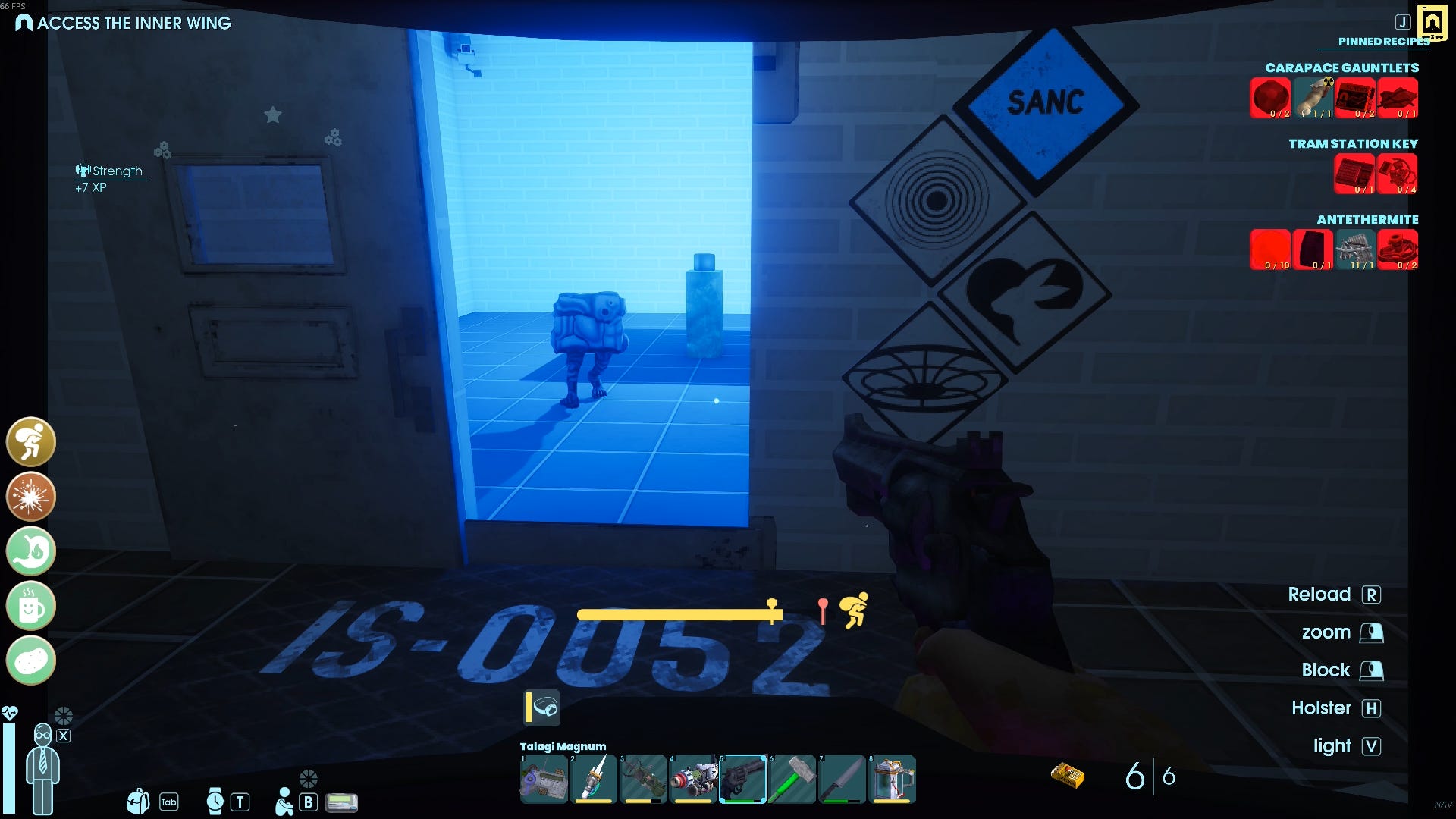
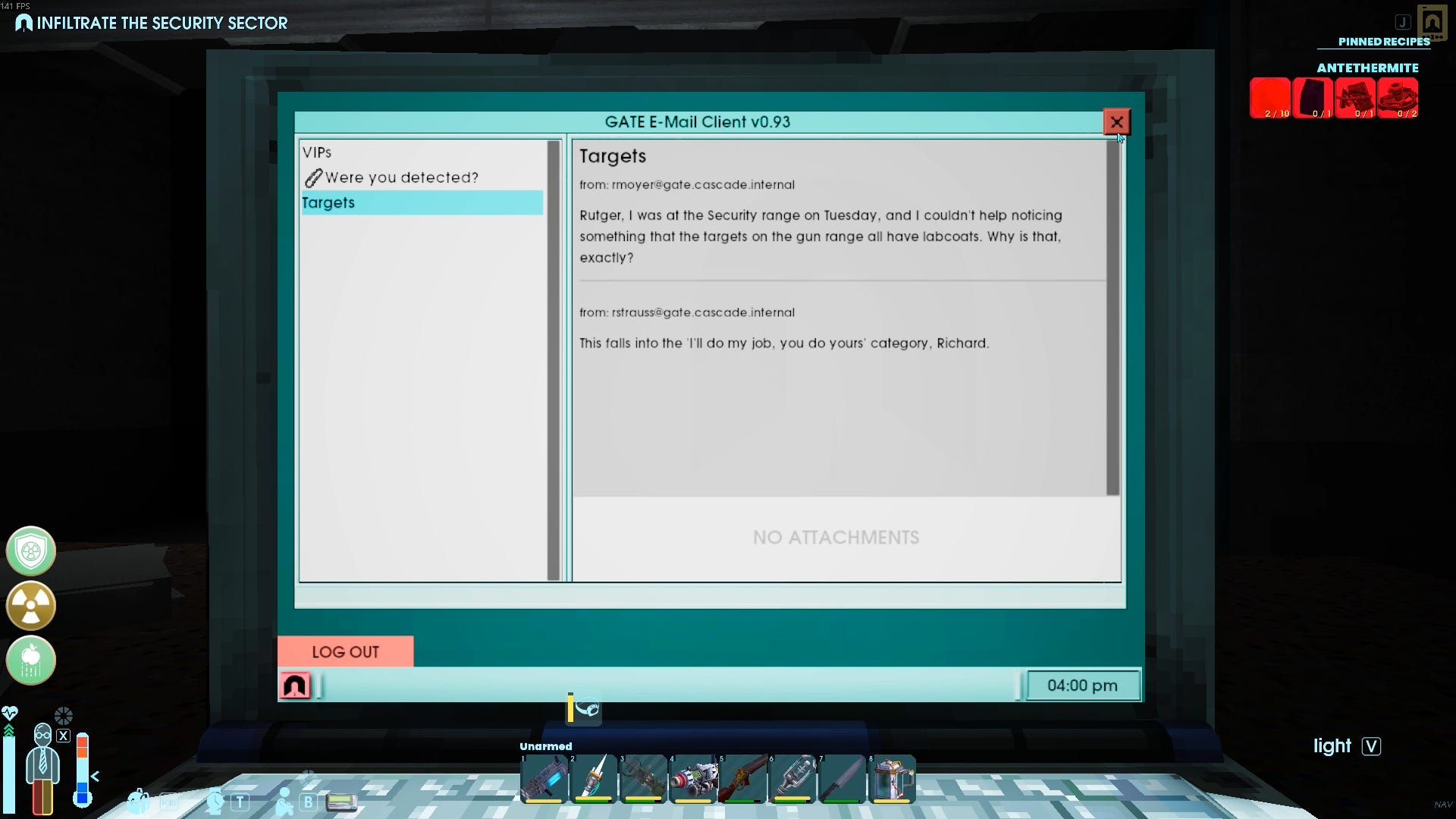
The facility, and its sister facilities around the globe, have been dabbling in interdimensional excursions, bringing back all sorts of oddities, hostilities, and entities to catalogue, prod, and expound upon in audio logs, emails, and whiteboard doodles. One of my favorite areas is the Containment complex of the Labs sector, with floor after floor of prison-style isolation chambers, each housing [or intended for housing] a single anomalous thing like a Victorian curiosity cabinet on a vast scale. After the instigating incident of the game’s intro, and subsequent widespread containment failure, the notes and theories regarding all of the objects, creatures, and artifacts become more than idle curiosity, and the game does a good job of filtering in new horrors from its roster of indescribables in a real gameplay capacity.
The majority of the audio logs you can find are in the voice of the facility’s Director, a character who could easily have been written as cornily incompetent, hackily compromised, or just too dumb or extreme in one way or another to be taken seriously – instead, he was easily my favorite character, despite never appearing in person, giving a measured and surprisingly sympathetic overview of the characters, creatures, and existential threats he was wrangling. Many of your direct conversations with survivors are also very good, and there’s a nice balance of humor and professionalism in most of the writing, making the staff feel like believably intelligent researchers confronting a menagerie of challenges to every established scientific principle. Yet there’s still room for silly shit like an evil snowman, a teleporting vending machine that dispenses radioactive sodas, or a hat that is inexplicably impossible to keep on.
The game’s art and graphics are… committed. The end result is likely polarizing – it’s stylized, and highly detailed, but not particularly attractive or easily readable. It doesn’t quite look like a real HL1 homage, and despite the modern resolution and framerates, it’s sometimes even more blurry and indistinct, or cluttered, or just too dark. And don’t get me started on the flashlights. The over-the-top jury-rigged and duct tape improvised look of most early equipment clashes with the glowy high-tech look of most later equipment, and there’s not really a good middle ground besides a handful of generic firearms. Finally, the UI is a little obnoxious, and the game occasionally channels the memes of 2000’s era UI overload.
The exploration is by far my favorite part of the game, but even it gets to be too much at times. Some areas are just too tedious to traverse, too resource intensive to constantly fight your way through, too… too goddamn BIG! I’m pretty bad about getting lost in first person games, and especially in old FPSes, and Abiotic Factor occasionally felt like the worst I’ve been in years. Even early areas had me circling around, looking dumbfounded at an elevator, wondering if I should see where it goes, or if it would just confuse me more. The game doesn’t have a proper in-game map, just a series of posted ‘you are here’ maps like the world’s most poorly laid out shopping mall, and even once you’ve gotten to a new area, you then have to spend a ton of time figuring out how best to leave it and come back.
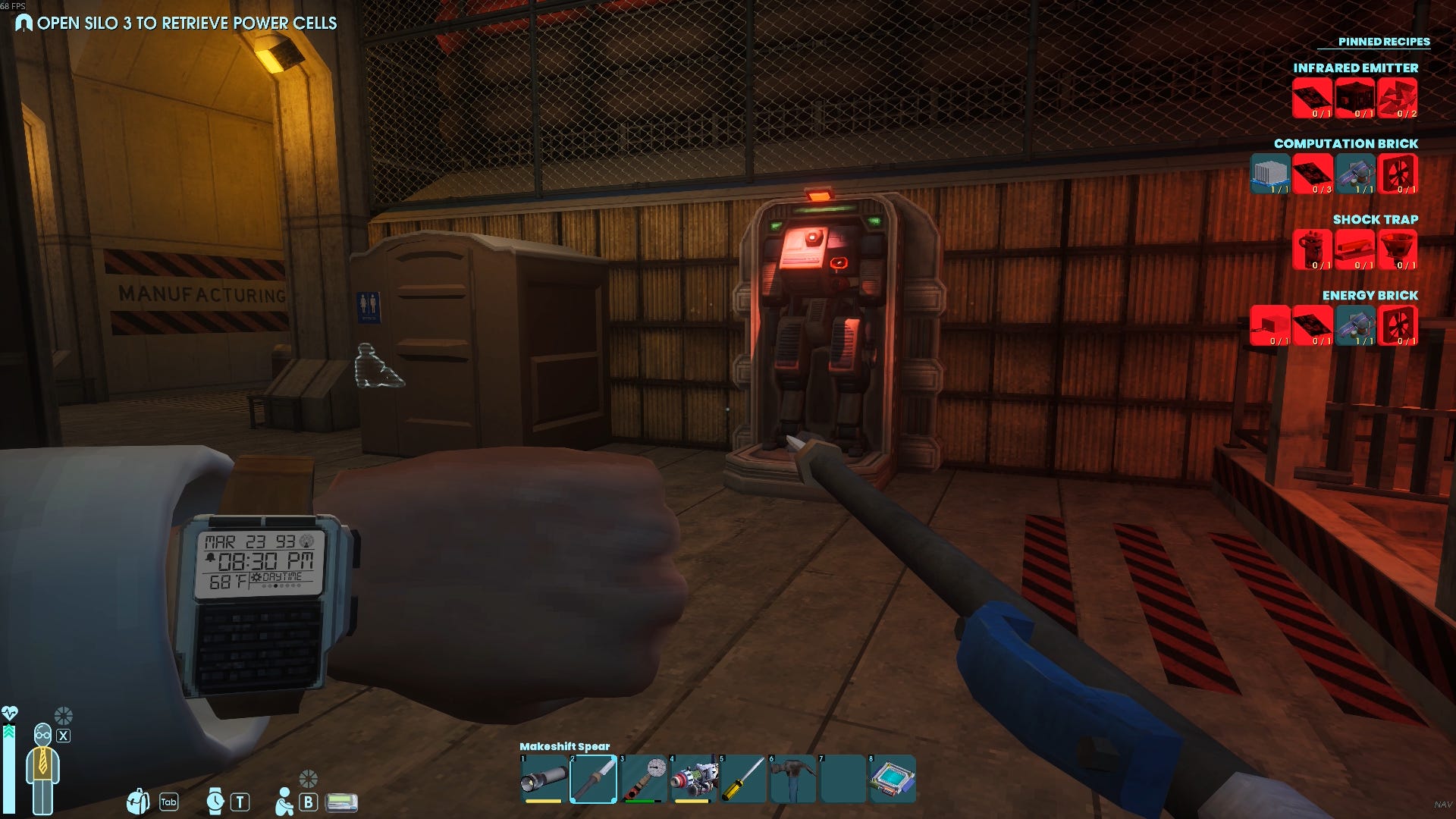
It’s often pretty hard to figure out what you’re actually supposed to be doing, too. The game updates your objectives, and usually even has a floating marker hovering over the next major transition point, but figuring out how to get there, or how to find the items that will let you get there, or finding the portal that takes you to an Anteverse where the item… you know, you get the idea. There were a few times where I just got so completely stuck and lost that I had to look up the solution, and most of those times I genuinely felt like I’d have never stumbled onto the correct path on my own.
Around the midgame you gain the ability to make little handheld teleporters that sync to workbenches, which lets you set up a kind of fast-travel network that only requires a bit of inventory shuffling and a lot of standing around as things recharge, but while it cut down on my walking time, it also wound up being a double edged sword, as I was less inclined to leave anything behind when I could tap a hotkey and be back at my base in seconds. Eventually I was just bringing along the parts to make a new workbench everywhere to serve as a crude checkpoint. Speaking of checkpoints, when you die, you have a choice of a few respawn options – you can start back at the cafeteria, at your last ‘claimed’ bed, or at the last claimed ‘checkpoint,’ one of which is placed at the start of each sector. Those checkpoints are rarely very useful, especially once you unlock the ability to make teleports, and while you keep any items in your hotbar on death, the occasional corpse run to recover the rest of your inventory is usually more annoying than thrilling.
The game itself is also quite long, and not particularly well paced. I suspect this is mostly a result of its stay in Early Access, with later sectors and areas kind of… stitched onto the pre-existing levels a bit awkwardly, and most of the endgame is just a fairly linear slog full of forced combat. Everything after Reactors felt pretty inessential, and I think I would’ve come away from the game a bit more satisfied overall if it’d ended there.
I didn’t opt to play the game in co-op, and while it is eminently completable solo, I do think it would probably leave a much stronger impression if you had someone to share the experience, the burden, and the exploration with. Unfortunately, unless you specifically go out of your way to set up a dedicated server, one person will have to host the world any time anyone involved wants to play. On a more positive note, the game has some nice features for immersion and playability, like proximity voice that can be supplemented with walkie-talkies, a device that lets you share discovered recipes, and the ability to rescue downed teammates. I also distinctly imagine having at least two players would alleviate the headache of a few enemy types, like the stupid fucking riot shield troops who just shuffle around facing you at all times with only their ankles exposed… until they crouch to hide their ankles.
With the little I experimented with the co-op, the only annoying thing I noticed was the limited character voice profiles meaning it’s easy to assume your scientist is the one complaining if your buddy is getting thirsty nearby or something. You also get a wide selection of customization options when you start a new world, which can reduce or even remove some of the less enthralling ‘features,’ like the ‘shit yourself buddy’ meter and the pointless minigame where you have to guess at what ingredients go into each recipe to ‘learn’ them. You can even adjust the time scale and respawning, which is the sort of thing I’d like to see a lot more games of this type give players control over, at least when setting up a totally custom server.
Abiotic Factor is a lot more than the sum of its parts – even if you don’t really care for crafting/survival co-op games, as long as you don’t utterly hate them, you’ll probably find plenty to get engrossed with beyond juggling meters and progressing up a tech tree. It’s an ambitious game, and by and large it makes good on its ambitions. It doesn’t always stick the landing, but it’ll limp along after each awkward impact until it recovers. Now GO TO THE BATHROOM.
Abiotic Factor can be purchased on Steam, Xbox, and Playstation 5.
I had a lot of fun with this game in co-op, but think I would struggle to enjoy it as much if I played it solo! I LOVED the Leyak enemy though — made me jump the first time it just appeared and killed me, ended up setting a timer to keep an ear out for its sneaky approach!